
5 Steps to Validate High-Impact Assumptions
Most bad product bets fail for a simple reason: teams test the easy stuff first instead of the risky stuff. If 42% of startup failures come from no market need, the smart move is simple: find the assumptions that could sink the idea, test them first, and make decisions from proof instead of hope.
Here’s the short version of the process:
- List your assumptions and separate them from facts
- Score each one by how much damage it would cause if wrong and how little proof you have
- Test the top risk first with a small, low-cost experiment
- Set pass/fail rules before the test starts
- Update your plan based on what the results say
- Repeat as the next biggest risk shows up
I’d boil the article down to one point: don’t build first; test the belief most likely to break the business. That means starting with customer and problem assumptions, looking for behavior-based proof like clicks, deposits, booked calls, or LOIs, and avoiding long MVP builds before you know demand is there.
A few numbers stand out:
- A lean test may cost about $500 to $5,000
- A six-week validation cycle may cost $2,000 to $8,000
- A six-month MVP build can run $25,000 to $80,000
- A two-person technical team can burn about $30,000 per month
The takeaway: I’d use this 5-step loop to cut waste, lower guesswork, and decide when to proceed, change direction, retest, or stop.
| Step | What I’d Do | Main Goal |
|---|---|---|
| 1 | List and classify assumptions | Turn vague beliefs into testable statements |
| 2 | Rank by impact and evidence gap | Find the top risk |
| 3 | Run a small test | Get behavior-based proof |
| 4 | Compare results to pre-set thresholds | Make a clear decision |
| 5 | Re-score and repeat | Work through risk one item at a time |
If I were using this in practice, I’d treat it like a simple loop: write the assumption, test it, score the result, then move to the next risk.
How to Validate Your Startup Idea for $50 (Same Method That Built a $100M Brand)
::: @iframe https://www.youtube.com/embed/-nvJIfQnidw :::
Step 1: List and classify your core assumptions
Founders often blur the line between assumptions, facts, and plans. Put your assumptions in one place so you can look at them without the fog.
A simple way to do that is to map the path from discovery to value and ask: "What must be true for this step to work?" That question tends to bring hidden assumptions into the open. New ventures often uncover 20–30 assumptions across customer, problem, solution, pricing, acquisition, and feasibility[1]. And most founders miss a lot of them. In many cases, they undercount by 3–5x because they treat personal beliefs like proven facts[4].
Use the categories below to turn broad beliefs into statements you can test. The table shows what each category includes and what a testable statement can look like:
| Category | What It Covers | Example Testable Statement |
|---|---|---|
| Customer | Specific segments, budget authority, switching costs | "Procurement managers at food processing companies with 200+ employees will prioritize waste reduction over cost savings." |
| Problem | Existence of pain, frequency, failure of current workarounds | "At least 60% of general contractors independently describe scheduling conflicts as a top-three operational pain point." |
| Solution | Core value delivery, usability, workflow fit | "Users will replace their current ticketing setup with our tool if it costs less than $300/month." |
| Pricing | Willingness to pay, sustainable margins | "Small retailers will pay $99 per month for automated inventory alerts." |
| Acquisition | Channel scalability, cost per lead, message fit | "We can reach compliance officers via LinkedIn ads at a cost per qualified lead below $200." |
| Feasibility | Technical barriers, regulatory constraints, resource availability | "We can hire three specialized engineers within 6 months to build the core algorithm." |
The next move is simple: rewrite each assumption so it can either pass or fail.
One practical rule helps a lot here: test problem and customer assumptions before solution or acquisition assumptions. If the problem isn’t there at the scale you think it is, then the rest of the work starts to wobble.
Turn idea components into testable statements
A vague assumption like "customers will like this" doesn’t give you much. You can’t measure it, and you can’t tell if it failed. The fix is to rewrite every assumption in a concrete format: "[segment] will [action] because [reason] at [price or rate]."
That small shift changes everything. Instead of saying, "people will sign up," write: "8 out of 12 target users will describe [Problem] as a top-3 pain point unprompted." Instead of saying, "businesses will pay for this," write: "Small retailers will pay $99 per month for automated inventory alerts." These statements give you a clear subject, a measurable action, and a threshold you can check.
Belief is not evidence. If an assumption can’t be measured, rewrite it until it can.
Tell apart normal assumptions from leap-of-faith assumptions
Once you’ve built the list, don’t treat every item as equally urgent. Some assumptions are just normal business guesses. If they’re wrong, you make a small shift. Maybe you swap a marketing channel, change a price, or adjust a feature.
Leap-of-faith assumptions are different. If one of those fails, the whole model can fall apart[1][4].
A simple filter works well here:
- How bad is failure?
- How much evidence do we already have?
Low evidence plus high impact usually points to a leap-of-faith assumption[1][4]. That’s where your testing effort should go first.
A structured workspace like InspectIdea can help you log each assumption and attach evidence like interview notes or click-through rates. After the list is done, score each assumption by impact and evidence.
Step 2: Prioritize assumptions using an impact and evidence matrix
Now take the list from Step 1 and sort it with a simple 2-by-2 matrix. The point is simple: you can’t test every assumption at the same time.
One axis is impact: how much damage the business takes if the assumption is wrong. The other is evidence: how much proof you already have. Put each assumption on the grid, and the order of testing gets a lot easier to see.
The first place to look is the high impact / low evidence quadrant. Those assumptions should be tested first. A lot of teams do the opposite and test whatever feels easiest instead of what carries the most risk [1].
How to score impact and evidence
Use a 1-to-5 scale for both axes.
For impact, ask: If this assumption is totally wrong, how bad is the hit?
A score of 5 means the business model falls apart. A score of 1 means the mistake is small and fixable.
For evidence, ask: What proof do we have right now?
A 5 means you’re mostly guessing. A 1 means you already have strong proof based on actual behavior or transactions.
The kind of proof matters just as much as the amount. Verbal praise is weak. What carries more weight?
- Observed behavior
- Unprompted descriptions of pain
- Financial commitment
After scoring both, multiply them to rank the assumptions:
Priority = Impact × Evidence Gap [3]
That gives you a simple way to see what needs attention first.
What to test now, watch, or defer
Use the matrix to sort assumptions into action buckets:
| Quadrant | Recommended Action | Typical Risk | Example Assumption |
|---|---|---|---|
| High Impact / Low Evidence | Test Now | Existential; leap-of-faith | "Customers will pay $45,000 per year for this service." |
| High Impact / High Evidence | Monitor | Known but critical | "Our infrastructure can handle the data load." |
| Low Impact / Low Evidence | Defer / Test Later | Minor unknown | "Users prefer a specific UI color scheme." |
| Low Impact / High Evidence | Ignore for now | Low risk; already known | "Our target users have access to high-speed internet." |
What you end up with is a ranked list of tests to move into Step 3.
Step 3: Run Lean Tests for Your Riskiest Assumptions
::: @figure 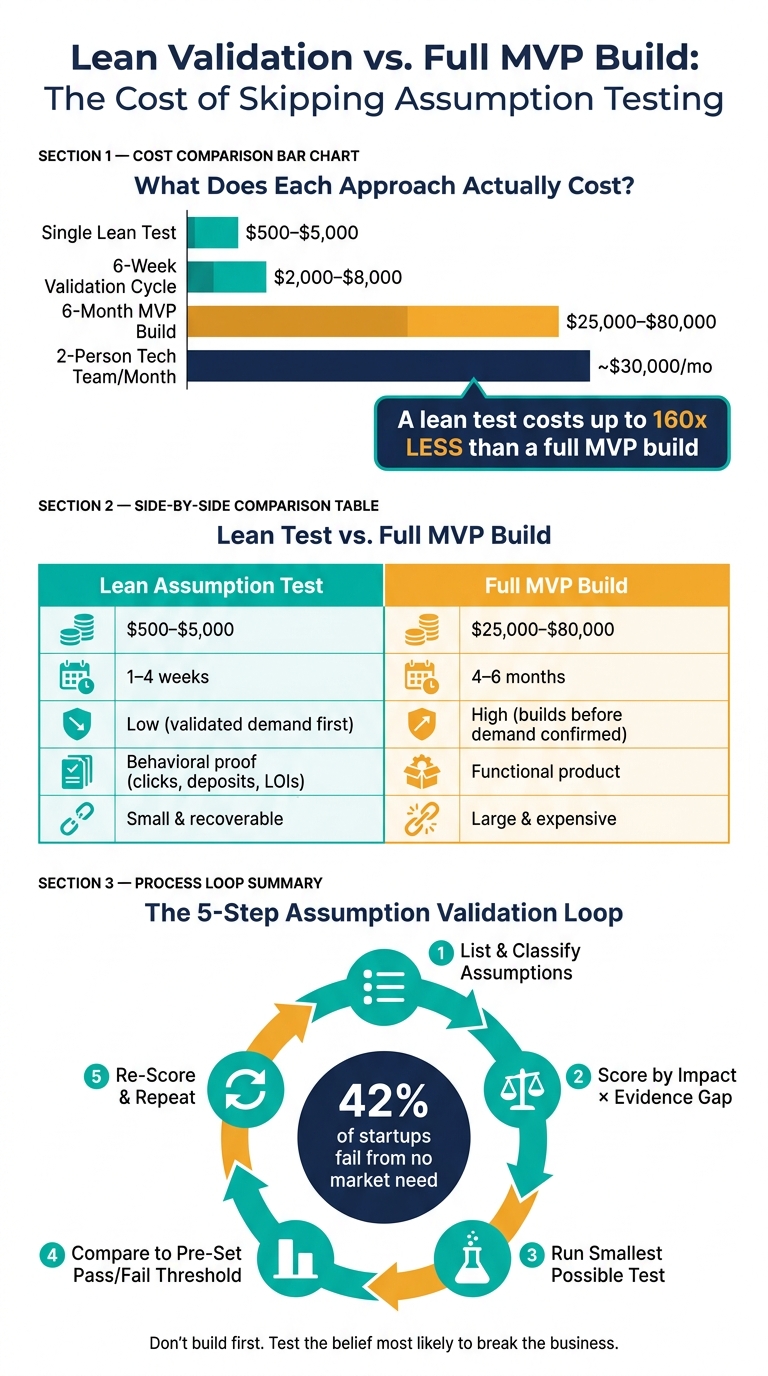 {Lean Validation vs. MVP Build: Cost & Risk Comparison}
:::
{Lean Validation vs. MVP Build: Cost & Risk Comparison}
:::
You now have a ranked list of assumptions from Step 2. Next, test the top risk - not every assumption at once. Go after the one that could hurt the idea most if it's wrong. And do it fast, on a tight budget, without building more than you need. Start with the assumptions from Step 2 that have high impact and low evidence.
A six-week validation cycle usually costs $2,000 to $8,000. A six-month MVP build, on the other hand, can cost $25,000 to $80,000 - and that's before you've confirmed that anyone wants what you're making [5]. Lean tests help you avoid that trap.
Match Each Assumption Type to the Right Test Method
The test needs to fit the assumption. If you run a usability session to check willingness to pay, or put up a landing page to test whether the problem is painful enough, you're likely to get noise instead of signal. Each method answers a different question.
| Assumption Type | Example Assumption | Suggested Test Method |
|---|---|---|
| Problem / Pain | Customers feel acute pain around slow code reviews. | Problem Interviews (focus on past behavior, not future intent) |
| Desirability | Users will choose this solution over existing alternatives. | Clickable Prototype or Concierge MVP |
| Demand | There is enough market interest to sustain a business. | Landing page or waitlist test |
| Willingness to Pay | Customers will pay $49/month for the automated version. | Pre-orders, Deposits, or Pricing Page Test |
| Usability | Users can successfully navigate the core workflow. | Usability Sessions or Concierge MVP |
| Switching Cost | IT departments will approve a third-party data connection. | Letters of Intent (LOI) or Partner Commitment Letters |
What counts here is behavioral proof. Look for signals like:
- Pre-orders
- LOIs
- Booked calls
- Deposits
Those actions tell you far more than polite feedback ever will.
Keep Experiments Small, Fast, and Low-Cost
Each test should have a narrow audience, one learning goal, and a four-week cap. If a test runs longer than four weeks, it's probably doing too much.
Get specific with the audience. "Series A CTOs" is testable. "Managers" is too broad. Keep the learning goal just as tight: one test, one assumption. If you bundle two questions into one experiment, you won't know what the result actually means [2].
InspectIdea can log each assumption, test, and evidence note in one place.
"The goal isn't to feel confident. The goal is to become less wrong with each experiment." [7]
Set your pass/fail threshold before the test starts - not after you've seen the numbers. For example: "At least 15% of target users click the pre-order button" or "At least 5 out of 20 target customers say they would pay $X." Write that threshold down now so Step 4 can compare the outcome against it.
Step 4: Set Success Metrics, Review Evidence, and Update Your Roadmap
Step 3 gave you the data. Step 4 is where you make the call: compare the result against the threshold you set ahead of time, then decide whether to proceed, iterate, pivot, or stop.
Set Pass/Fail Thresholds Before the Test Starts
Write the threshold down before the test begins. Then leave it alone after the results come in.
That matters more than it may seem. If you change the rule after seeing the data, you're not testing anymore. You're just moving the goalposts.
Here’s a simple reference table that shows how this can work across common assumption types:
| Assumption Category | Sample Metric | Example Decision Rule |
|---|---|---|
| Desirability | At least 25% of qualified visitors click "Get Started" | Proceed if >25%; Iterate if 10–24%; Pivot if <10% |
| Desirability | 6 out of 10 interviews rank this problem in their top three pain points | Proceed if ≥6; Iterate if 4–5; Pivot if <4 |
| Viability | Fewer than 2 out of 10 target companies sign a Letter of Intent (LOI) | Stop if <2; Change Offer if 2–3; Proceed if ≥4 |
| Feasibility | System achieves a 95% accuracy threshold within a 4-week sprint | Proceed if ≥95%; Retest if 90–94%; Kill if <90% |
If the result is inconclusive, retest with a narrower question.
Record Outcomes and Update Priorities Based on Proof
Use those same rules to update your roadmap.
After the test, tag the assumption as Validated, Invalidated, or Inconclusive. Then score it again on the matrix. An invalidated assumption still helps you. It gives you proof, and that proof should change what you do next.
Each test result should lead to one of four decisions: Persevere (move to the next riskiest assumption), Pivot (change a variable and test again), Kill (stop the project), or Retest (when the data is genuinely inconclusive) [2][6].
| Assumption | Original Rating | Test Outcome | Updated Rating | Resulting Decision |
|---|---|---|---|---|
| Target users will pay $49/month for this tool | High Impact / Low Evidence | 0/20 pre-sell pitches converted; 15/20 cited price as too high | High Impact / High Evidence (Invalidated) | Pivot: Test a $19/month price point or a different segment |
| Ops managers lose more than 8 hours/week on this task | High Impact / Low Evidence | 12/20 interviewed managers confirmed 8–10 hours/week lost | High Impact / High Evidence (Validated) | Persevere: Move to testing solution-fit assumptions |
| IT will approve a third-party data connection | High Impact / Low Evidence | 8/10 IT managers said security policy blocks this | High Impact / High Evidence (Invalidated) | Kill/Pivot: Explore an offline or on-premises solution |
InspectIdea can help with this step directly. It stores research notes, tags evidence, and tracks how risk levels shift across assumptions over time as new tests finish. It also tracks risk reduction over time.
Carry that updated ranking into the next review cycle.
Step 5: Repeat the process as new risks appear
Use the updated ratings from Step 4 to pick the next test. One validated assumption does not validate the whole business model. Re-score the assumptions that are still left, then test the one with the highest risk next.
This is a rolling process. As one risk drops, the next highest-risk assumption moves to the top of the list. So the next test should come from the current highest-risk item in the matrix, not from some fixed category order.
Build a simple review cadence
The matrix should guide every next test. For small teams, a weekly or biweekly review is enough to keep things moving without adding noise [2][1].
During each review:
- Re-score the remaining assumptions based on new evidence
- Confirm which assumption now has the highest risk score (Impact × Evidence Gap)
- Decide what to test next
Conclusion: A repeatable 5-step process to cut costly mistakes
Most teams don’t fail because they aren’t working hard. They fail because they test the wrong things first. That’s where these five steps help: they fix the order before it turns into expensive rework.
Here’s the process in plain English: list your assumptions, rank them by impact and evidence gap, run the smallest test that can answer the question, decide with pre-set thresholds, then do it again. Simple on paper, but it changes a lot in practice. You rank risk, test fast, and update the plan based on what you learn. Since you can’t test everything at once, start with the assumptions most likely to break the business model.
The cost difference is hard to ignore. A two-person technical team can burn about $30,000 per month. By contrast, a riskiest assumption test may cost $500 to $5,000 and take one to three weeks. That’s a much cheaper way to find out whether you’re heading in the right direction.
For founders and product teams, the upside is simple: better decisions before you commit headcount, runway, or a full build. InspectIdea can help teams map assumptions and track evidence in one workspace. Then you can run the cycle again as new risks show up.
FAQs
::: faq
How do I spot a leap-of-faith assumption?
Use an assumption mapping exercise. Plot your assumptions on a 2x2 grid with importance on one axis and evidence on the other.
Leap-of-faith assumptions sit in the high-importance, low-evidence quadrant. These are the riskiest ones. Your project depends on them, but you have the least data to back them up. InspectIdea can help you map and stress-test those assumptions. :::
::: faq
What kind of evidence is strong enough to validate an assumption?
Strong evidence comes from observed behavior. What people do matters more than what they say, especially when that action costs them time, money, or social capital. The strongest signal of all is actual revenue from paying customers.
By contrast, self-reported interest and hypothetical feedback are weak signals. Someone may say they’d use a product, love an idea, or pay for a feature. That sounds good on the surface. But until they take action, it’s just talk.
To make evidence mean something, set clear success criteria before you test. That way, you’re not moving the goalposts after the fact. In customer interviews, put the spotlight on past behavior instead of opinions about future features. Ask what people have already done, paid for, tried, or struggled to solve - not what they might do someday. :::
::: faq
What should I do if a test result is inconclusive?
An inconclusive result usually means the starting assumption wasn't clear enough. Most of the time, that happens for one of two reasons: the assumption is too vague, or the test is trying to check too many things at once.
Tighten the assumption so it's singular, specific, and measurable. Then run the test again.
InspectIdea can help you sharpen assumptions and set up experiments with clear pass/fail signals, so the results point to action instead of ambiguity. :::