How to Validate a Business Idea Before Building
Don’t build first. Test first. If you want to avoid one of the biggest startup mistakes, look for proof that people will act, not just say “nice idea.” That matters because 42% of startup failures happen because there’s no market need.
Here’s the short version of how I’d validate a business idea before spending months building it:
- Define the problem clearly
- Pick one specific customer group
- List the assumptions that could sink the idea
- Interview 20–50 people who match that customer
- Look for past behavior, current workarounds, and money already spent
- Run a simple landing page or smoke test
- Measure actions like sign-ups, booked calls, deposits, or pre-orders
- Check search demand, market size, and weak spots in competing tools
- Score the evidence and decide: move forward, change direction, or stop
The main point is simple: words are weak, actions matter. A waitlist signup is better than praise. A booked call is better than a waitlist. A paid deposit or LOI is the strongest proof.
If I had to sum up the article in one line, it would be this: validate the problem before the product, and use buyer action to decide what to do next.
What I like here is the discipline behind it. Instead of guessing, you set a bar in advance, test one risky belief at a time, and keep a written record of what the market is telling you.
A few numbers from the article stand out:
- 42% of startups fail due to no market need
- Cold outreach may take 30 messages to get 5 solid replies
- Patterns often show up after 15–20 interviews
- A landing page can be built in about 30 minutes for under $20
- Test traffic can start with $50–$100 in ads
- 5%+ landing page conversion can point to strong interest
- Below 2% can point to weak pain or weak messaging
One part that’s especially useful is the decision step. Instead of relying on hope, I’d score the idea on:
- Problem severity
- Market size
- Willingness to pay
- Competitive gap
- Customer acquisition feasibility
Then I’d use the score to make the call.
::: @figure 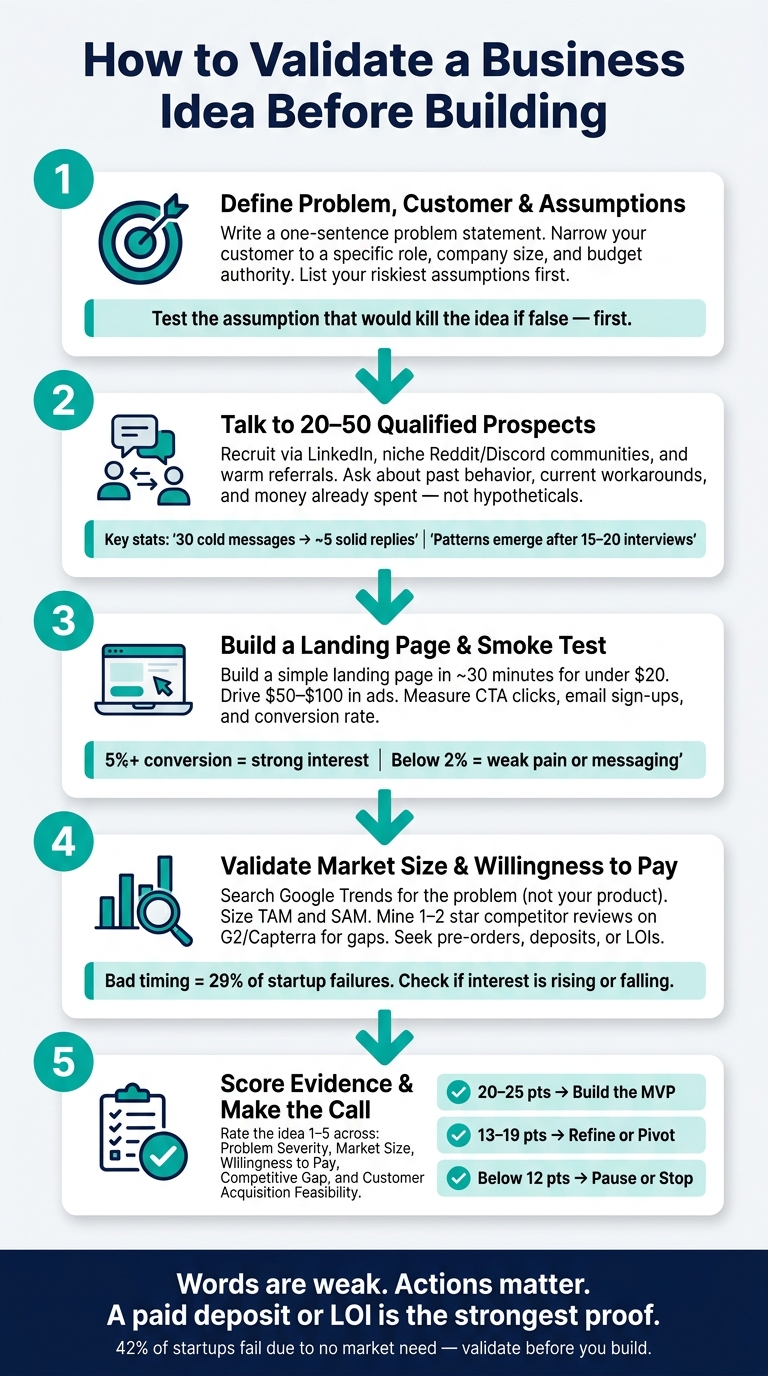 {How to Validate a Business Idea Before Building (Step-by-Step)}
:::
{How to Validate a Business Idea Before Building (Step-by-Step)}
:::
Test Your Startup Idea in 2 Days (Before You Build Anything)
::: @iframe https://www.youtube.com/embed/tytX0xTcDTY :::
Quick Comparison
| Stage | What I’m checking | Best signal |
|---|---|---|
| Problem | Is this pain real and frequent? | People describe a recent problem on their own |
| Customer | Am I talking to the right people? | They match the buyer profile and face the same issue |
| Demand | Will strangers take action? | Waitlist signups, CTA clicks, booked demos |
| Payment | Will people pay now? | Deposit, paid pilot, pre-order, or LOI |
| Decision | Should I build, change, or stop? | Score based on evidence, not opinion |
So if you’re sitting on an idea, the takeaway is clear: don’t ask “Would you use this?” Ask for action. That gives you a much better shot at knowing whether to build, change the offer, or walk away before you burn time and money.
Define the Problem, Customer, and Assumptions First
Before you run any test, pin down three things: the problem, the customer, and the assumptions behind the idea. If you skip this, feedback gets messy fast. You'll hear reactions, but you won't know what the evidence is testing. Is the problem weak? Is the audience wrong? Or is one key belief falling apart?
Use these definitions to keep every interview and demand test aimed at the same core question: is the problem real, who has it, and what must be true for this idea to work?
Write a Clear Problem Statement
Write the problem statement in one sentence. A testable problem statement should include the exact customer segment, the pain point or risk, what people do today to deal with it, and what must be true for a better solution to work [4].
In practice, only must-solve problems tend to drive adoption and payment. If people already lean on spreadsheets, manual work, or awkward tools, that's a strong sign the problem exists [8].
Then tighten the customer definition so your evidence comes from the right people.
Define a Specific Target Customer
Broad audiences lead to noisy feedback. "Small business owners" or "entrepreneurs" isn't a target. It's just a bucket. Go narrower by role, business type, company size, location, and budget authority.
Your target customer should be specific enough that you can picture the person and describe their job in plain English. Keep that definition in one place so every signal ties back to the same segment.
Once the customer is clear, write down the assumptions that need to hold for the idea to work.
List Your Riskiest Assumptions First
Every business idea rests on assumptions. Put them in writing. Common examples include whether the problem happens often enough and hurts enough to matter, whether you can reach buyers without spending an unrealistic amount, and whether customers will pay $X instead of sticking with the workaround they already use.
After that, find the single assumption that would kill the idea if it turns out to be false, and test that first [4]. Keep all assumptions in one place so you can score new evidence against them later.
The table below shows the difference between a weak signal and a strong signal across common assumption types:
| Assumption | Weak Signal | Strong Signal |
|---|---|---|
| Problem severity | "That sounds like a great idea." | Customer describes a specific, recent instance of the pain unprompted. |
| Current workaround | "We should probably find a tool for this." | They already pay for a workaround or use a spreadsheet. |
| Willingness to pay | "I would definitely use a free version." | Customer asks about pricing, implementation, or signs a Letter of Intent (LOI). |
| Buyer access | User likes the feature, but not enough to act. | User introduces you to the person who controls the budget. |
| Frequency | "This might come up occasionally." | The problem occurs at a predictable, recurring trigger point. |
Talk to Potential Customers Before Building Anything
Before you build, test the problem first. The simplest way to do that is with customer interviews. At this stage, you're not pitching a product. You're checking whether the problem is real, painful, and common enough to matter.
Start with the riskiest assumptions you listed earlier, then use interviews to prove them wrong or right with actual prospects.
Recruit 20 to 50 Qualified Prospects
Talk to people who match your target customer profile. Friends and coworkers usually want to be nice. That can lead to polite feedback instead of solid evidence.
LinkedIn is a good place to start. You can filter by job title, company size, and industry to reach people who fit your target customer. Niche Reddit communities, forums, and Discord servers can help too, especially when you want to spot unprompted complaints about the exact problem you're looking into. Warm introductions from early interviews also help. At the end of each call, ask who else you should speak with.
Expect a lot of drop-off. Cold outreach on LinkedIn often takes about 30 messages to get 5 meaningful replies [3]. Keep your message short and non-salesy. Say you're researching the problem and want 15 minutes. And if you can't find 20 willing prospects, that's a signal too [3].
Before booking a call, use a short Typeform or Google Forms screener. This helps filter out people who don't deal with the problem or don't have the authority to do anything about a fix.
Ask About Behavior, Pain, and Spending
Keep the conversation grounded in the past, not some imagined future. Hypothetical answers sound nice, but they don't tell you much. Each question should test one of your riskiest assumptions.
Focus on three things:
- When the problem last happened
- What they tried instead
- What it cost them in time, money, or lost opportunity
If someone already paid for a workaround, even a clunky one, that's a strong sign the problem is worth solving.
After every interview, tag what you learned as either validation or counter-evidence in one running document. It keeps your notes clean and makes patterns easier to spot once the interview count starts climbing.
What Customer Interviews Reveal and Where They Fall Short
Patterns often start to show up after 15 to 20 interviews. Pay close attention when someone gets frustrated while describing a specific workflow. That's usually where the pain lives.
Good signals include a prospect bringing up the problem on their own, sharing internal data or workflows, or offering to connect you with the person who controls the budget. Praise doesn't count as proof. As one benchmark put it:
"A compliment is 'that is a great idea.' Validation is a deposit or a signed pilot, something that cost them to hand over." - Preuve.ai [7]
The table below shows what interviews are good at and where they can mislead you:
| What It Reveals | Strengths | Limitations |
|---|---|---|
| Problem severity | Shows urgent, hair-on-fire pain versus mild annoyances | Prospects often overstate how much they'd change their behavior |
| Current workarounds | Shows what they already spend time and money on | It doesn't mean they'll switch to your solution |
| Customer language | Gives you exact phrases to use in future marketing copy | High risk of politeness bias if the founder pitches during the call |
| Buying triggers | Shows the moment the problem becomes urgent | Qualitative data is hard to scale or quantify on its own |
One smart safeguard: set your kill criteria before you begin. Decide ahead of time what evidence would make you stop. For example, if fewer than 3 of 15 buyers have already spent money on a workaround, stop [7]. That keeps you from twisting weak data into a green light. If interviews show repeated pain, the next step is a landing page or smoke test to measure demand.
Run Simple Online Demand Tests
Customer interviews show you the problem is real. Online demand tests show whether people will do something about it.
Once interviews confirm pain, the next step is simple: put your idea in front of strangers and see how they respond.
Build a Landing Page and Collect Waitlist Sign-Ups
A landing page doesn't need to be fancy. It needs to be clear.
You can build one in Carrd in about 30 minutes for under $20 [2], then collect emails with Typeform or Google Forms. Keep the page focused. Include:
- A headline that states the promise
- A sub-headline that explains the outcome
- Three to five core benefits
- One CTA button
Then put a small ad budget behind it. Spend $50–$100 on Google or Meta ads to reach your target customer and gather data in two to three days [5].
Track these numbers closely:
- Unique visitors
- CTA clicks
- Email conversion rate
A conversion rate above 5% points to strong interest. Below 2% usually means weak positioning or low pain [5].
If sign-ups come in soft, don't guess. Run a stronger intent test next.
Use Smoke Tests to Measure Intent
A smoke test goes one step further than a waitlist.
Instead of asking people to join a list, you place a high-intent button on the page, like "Buy Now" or "Book a Demo", even though the product doesn't exist yet. If someone clicks, show a short message right away explaining that the product is still in early development, then invite them to leave their email for updates [4].
That click matters. It shows more intent than a scroll [4].
The key here is honesty. Be transparent as soon as they click [4]. You're not trying to trick anyone. You're trying to measure how far people are willing to go.
Stronger signals include a pre-order deposit, a booked call, a credit card on file, or an introduction to the budget holder.
Landing Pages, Waitlists, and Smoke Tests Compared
Each test answers a different question. Pick the one that fits what you need to learn right now.
| Test Type | What You Test | Key Metric | Typical Cost | Best Suited For |
|---|---|---|---|---|
| Landing Page | Message clarity | Email conversion rate | $50–$100 [5] | Testing whether the problem resonates with a broad audience |
| Waitlist | Lead capture | Qualified sign-ups | Free–$20 [2][4] | Building an early audience before launch |
| Smoke Test | Purchase intent | CTA click-through rate | $50–$100 [5][4] | Validating whether visitors will take a high-intent action |
Set your success criteria before you launch anything. That part matters more than people think. For example, you might decide that if 20 people pre-order at $49 within two weeks, you'll build the product [5][4].
That way, you're not judging results based on mood or hope. You're using a clear bar. If demand shows up, move on to market size, search trends, and willingness to pay.
Check Market Signals and Willingness to Pay
Market signals tell you whether a market is worth entering. Clicks alone don't do that. After your demand tests, step back and check whether the market can support the idea.
Review Search Trends, Market Size, and Competitor Gaps
Start with Google Trends. But don't search your product name. Search the problem.
You want to see whether people are actively looking for a fix to the pain point you found, and whether that interest is growing, flat, or dropping year over year [7]. If the trend is going down, take that seriously. Timing is a big deal. Bad timing alone accounts for 29% of startup failures, so checking whether interest is rising or fading isn't something to skip [7].
Once you see the category has momentum, size it with a clear head. Use TAM to judge the total size of the market, and SAM to judge whether you can reach your first customers [3].
Then look at competitors. Map every current option the customer uses:
- Spreadsheets
- Manual work
- Assistants
- Agencies
This helps you spot where budget already exists [7][4].
Next, dig into 1-star and 2-star reviews on sites like G2 or Capterra [10][11]. You're not just reading complaints for the sake of it. You're trying to spot repeated frustration. Look for the one thing current tools keep refusing to do. That missing piece is your positioning gap [7].
If the market has room, the next step is simple: will people pay now?
Test Willingness to Pay with Pre-Sales or Paid Pilots
What matters here is action. Not praise. Not polite interest.
You're looking for something that costs the customer money, time, or access [1]. A pre-order deposit counts. A paid pilot with fixed scope counts. Any other concrete commitment can count too.
A phone call where someone says "sounds great" does not.
Tie pre-sales and paid pilots to the same actions you already tracked in interviews and smoke tests. They're the highest-intent version of those earlier signals. The point is to find proof of payment intent, not just book revenue.
How to Rank Interest Signals by Strength of Evidence
Not all signals mean the same thing. Some are light interest. Others show real intent. Use this table to judge how much confidence each signal deserves:
| Signal Type | Strength of Signal | Effort Required |
|---|---|---|
| Search Volume (Problem) | Moderate | Low |
| Competitor Review Gaps | Moderate | Medium |
| Email Waitlist Signup | Weak | Low |
| Letter of Intent (LOI) | Strong | High |
| Paid Pre-order/Deposit | Strongest | High |
If your best signal is still a waitlist, treat it as interest, not validation. Don't call the idea proven until you get a paid commitment or an LOI. Use these signals to score your assumptions.
Decide Whether to Refine, Pause, or Move Forward
You’ve done the interviews, tested demand, checked market signals, and looked at willingness to pay. Now comes the part that trips people up: making the call based on evidence instead of hope.
Go back to the same assumptions you set earlier and score them using what you learned. That keeps the decision tied to proof, not optimism.
Score the Evidence Against Your Assumptions
Use your interview notes, demand tests, and payment checks to rate the idea across five dimensions on a 1–5 scale: Problem Severity, Market Size, Willingness to Pay, Competitive Gap, and Customer Acquisition Feasibility [5][9].
Then add up the total and use this table to decide [5][6]:
| Total Score | Decision | What It Means |
|---|---|---|
| 20–25 points | Move forward | Strong validation; build the MVP |
| 13–19 points | Refine or pivot | Promising, but one major assumption needs retesting |
| Below 12 points | Pause or stop | Weak signal; park the idea to save resources |
Not all signals should carry the same weight. A deposit or LOI means more than a waitlist signup or a booked call because it asks for more commitment [7].
Keep one running log with your assumptions, the evidence tied to each one, and the decisions you made. It sounds simple, but it keeps you honest.
Pick Your Next Step and Document Why
Let the score decide the next move, not your enthusiasm.
If you land in Refine, change only one variable at a time, like the segment, price, or framing. If you change everything at once, you won’t know what actually made the difference.
If the score is below 12, stop and use the kill criteria you set before testing [7]. After each test, write down the result and the reason behind the decision, whether you moved ahead, refined the idea, or stopped. That record becomes the base for the next validation cycle or the next idea.
The discipline here is simple: validate the problem before the solution, measure what people do instead of what they say, and treat paid commitment as the strongest signal worth building on.
FAQs
::: faq
How do I know if my idea solves a real problem?
Look for proof in what customers do, not just what they say. The best signals come from action: pre-orders, deposits, waitlist signups, or people putting in time or money.
Customer interviews can help too. Keep them grounded in recent, real events. Ask what people tried, what didn’t work, and whether the problem shows up again and again with clear pain points and active workarounds. :::
::: faq
What if people like the idea but won’t pay for it?
If people say they like the idea but won’t pay for it, the best proof comes from money on the table: pre-orders, deposits, or signed letters of intent.
Nice comments and polite interest can feel good. But they don’t prove demand.
If interest never turns into payment, take a hard look at your positioning, pricing, or target audience. Curiosity alone doesn’t validate demand. :::
::: faq
When should I stop testing and start building?
Start building when you have strong evidence of demand. That means pre-orders, deposits, or booked calls from at least 5 people who have the problem, have already tried other options, and are willing to pay.
If your landing page or validation tests hit your predefined success thresholds, move ahead. If demand looks weak or people aren’t showing much commitment, pause or pivot before you build. :::