
Lean Validation vs. Full Market Research: Key Differences
Most startups do not fail because the market is small. They fail because people do not need what they built. One often-cited figure says 42% of startup failures come from no market need.
If I had to sum up the difference in one line, it would be this:
- Lean validation helps me test if people will act on my specific offer
- Full market research helps me judge if the market itself is worth a bigger bet
That split matters because the two approaches answer different questions, use different methods, and cost very different amounts.
Here’s the short version:
- Use lean validation first when I need a fast go/no-go answer
- Use full market research later when the decision is expensive or hard to undo
- Do not confuse interest with action
- Do not confuse a big market with demand for my product
Lean validation usually means things like:
- customer interviews
- landing pages
- fake-door tests
- pre-orders
- waitlists
It often takes 48 hours to 4 weeks and may cost $0 to $500.
Full market research usually means things like:
- market sizing
- competitor review
- large surveys
- pricing studies
- industry data review
It often takes 1 to 6 months and may cost $5,000 to $50,000+.
The main idea: I should start with the smallest test that answers the next decision. If people will not click, sign up, or try to buy, there is no point spending months sizing the market.
::: @figure 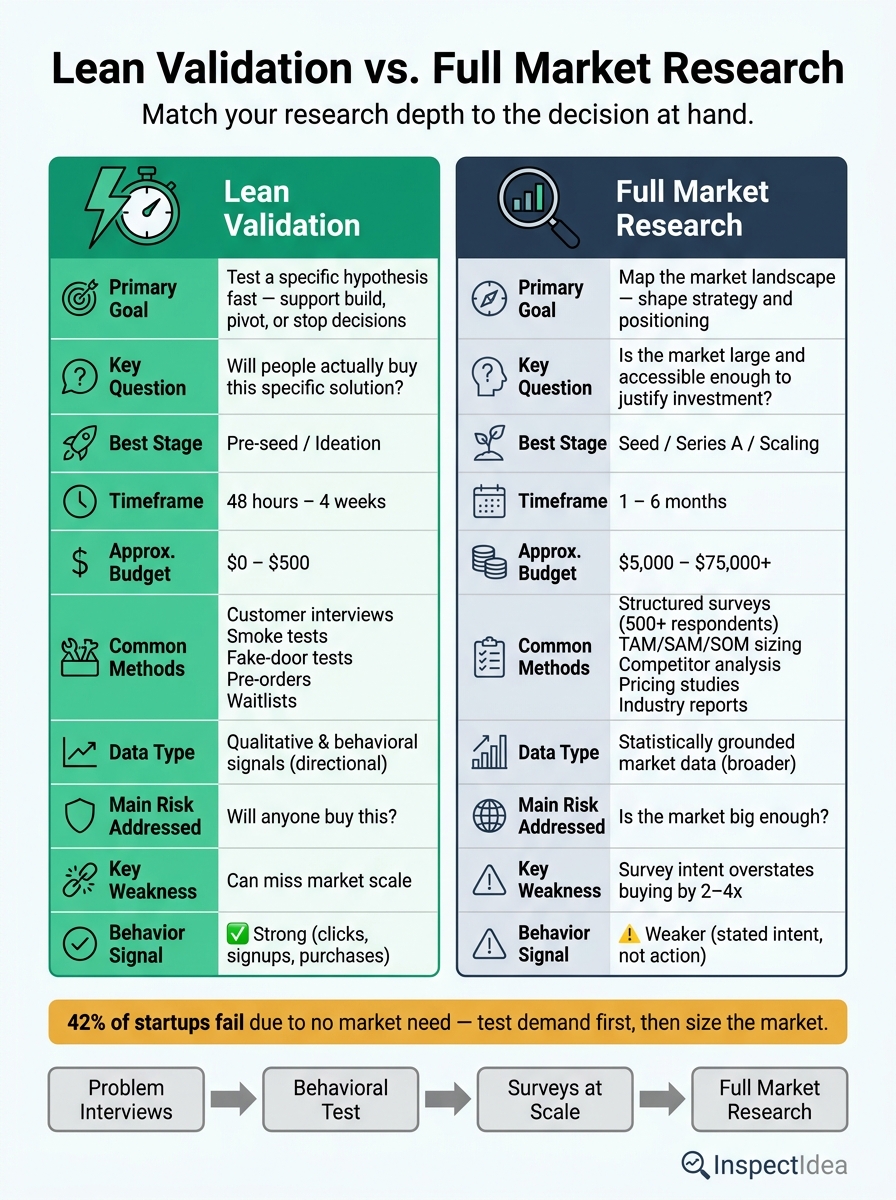 {Lean Validation vs. Full Market Research: Side-by-Side Comparison}
:::
{Lean Validation vs. Full Market Research: Side-by-Side Comparison}
:::
How to Validate Your Startup Idea (Lean Startup Methodology)
::: @iframe https://www.youtube.com/embed/wwuCVlHjZGI :::
sbb-itb-127d2b5
Quick Comparison
| Criteria | Lean Validation | Full Market Research |
|---|---|---|
| Main question | Will people buy this? | Is this market worth a bigger bet? |
| Best stage | Idea or pre-seed | Seed, growth, or bigger expansion moves |
| Time | Days to weeks | Weeks to months |
| Cost | $0–$500 | $5,000–$50,000+ |
| Main methods | Interviews, smoke tests, fake-door tests, pre-orders | Surveys, market sizing, competitor review, pricing work |
| Main signal | Behavior | Market data |
| Main weakness | Can miss scale | Can miss actual buying behavior |
The short takeaway is simple: lean validation tests demand first; full market research adds context after that. That order helps me spend less time and money on ideas that people may never want.
What Each Approach Actually Does
Lean Validation: Testing a Few Critical Assumptions Quickly
Lean validation focuses on the biggest risks behind an offer. Does the problem matter? Is there a real audience? Will people pay? More than that, will they pay you for this, not just say the idea sounds nice? The goal is simple: get to a go/no-go call as fast as you can by testing those points first.[2][1]
That usually means using smoke tests, fake-door tests, interviews, or email signups to look for behavioral signals in 48 hours to one week, often for $0 to $500.[2][4] Behavior beats opinion. Praise is not validation. A person saying, “I’d totally use this,” is not the same as clicking, signing up, or trying to buy.
For example, Waterboy used a TikTok post and landing page to confirm demand before production. [8]
That kind of signal tells you whether demand is there. Then the next job is figuring out where that demand fits in the market.
Full Market Research: Building a Broader Evidence Base
Once lean validation shows demand, full market research steps in to answer the bigger business questions: market size, competition, and segment fit. This is where you map the field - TAM, SAM, SOM, competitor positioning, customer segments, pricing psychology, and industry trends - so you can size the idea and place it before putting more money behind it.[1][4]
Common methods include:
- Surveys with 500+ respondents
- Price-sensitivity analysis
- Competitor analysis
- Secondary data review
This work usually takes weeks to months and often costs $5,000 to $50,000.[1][4] It makes sense when you're getting ready for a larger investment, building a go-to-market plan, or stepping into a market with messy competition and high stakes.
There's one catch: survey intent often overstates actual buying by 2–4x.[4] So while full market research gives you context and outside support, it doesn't replace the behavioral signals you get from lean validation.
How InspectIdea Supports Both Research Styles
Using both methods gives you a pile of evidence fast. That's useful, but it can also get messy. Assumptions, findings, and open questions need to live in one place, or confirmed facts start mixing with guesses.
InspectIdea gives you a structured workspace for that. You can spell out assumptions first, tag evidence as it comes in, and mark what still needs an answer. That keeps the idea moving cleanly from fast tests to deeper research.
Lean Validation vs. Full Market Research: Key Differences
Use this comparison to pick the right depth of research for the decision in front of you.
The simplest way to tell these two apart is to look at the decision each one is meant to support.
| Dimension | Lean Validation | Full Market Research |
|---|---|---|
| Primary Goal | Test a specific hypothesis fast and support build, pivot, or stop decisions | Map the market landscape and shape strategy and positioning |
| Timeframe | Days to weeks | Weeks to months |
| Approx. Budget | $0–$500[4][9] | $5,000–$75,000+[4] |
| Common Methods | Interviews, smoke tests, fake-door tests, pre-orders | Structured surveys, TAM/SAM/SOM sizing, competitor analysis, industry reports |
| Data Type | Directional learning from qualitative and behavioral signals | Broader, statistically grounded data |
| Best-Fit Stage | Pre-seed / ideation | Seed / Series A / scaling |
| Main Risk Addressed | Will anyone buy this specific solution? | Is the market large and accessible enough to justify the investment? |
This matters most when you're deciding what to do next.
Goals, Timing, and Decisions Each Approach Supports
Use lean validation when the big question is simple: Should we build this at all? It's built for early calls, when speed matters and you need signal fast.
Full market research fits decisions that are much harder to undo. Think capital allocation, moving into regulated markets, or signing long-term leases. In those cases, a rough read usually isn't enough.
Cost, Methods, and Data Quality
The cost gap is hard to miss. Lean validation usually runs from $0 to $500[4][9]. Full market research often lands between $5,000 and $75,000+[4].
The methods are different because the job is different. Lean validation leans on tools like interviews, smoke tests, fake-door tests, and pre-orders to get fast behavioral signals. Full market research uses structured surveys, TAM/SAM/SOM sizing, competitor analysis, and industry reports to build a broader market view.
That also changes the type of data you get. Lean validation gives you directional learning from qualitative and behavioral signals. Full market research gives you broader, statistically grounded data. One helps you test whether people act. The other helps you judge the size and shape of the market.
What Each Approach Can Miss
Lean validation can show early demand, but it can't tell you much about scale. A strong smoke test may prove people care, yet still fail to show that the market is big enough.
Full market research has the opposite weakness. It can size the market, but it can't prove buying behavior. And survey intent often overstates real buying behavior by 2–4x[4], which means a strong survey result can give teams false confidence before they've tested any behavioral signal.
That's why the sequence matters: use lean validation first, then full market research.
That tradeoff is why the right choice comes down to stage, risk, and budget.
How to Choose the Right Approach for Your Idea
The right method usually comes down to four things: stage, uncertainty, budget, and downside risk. Lean validation helps you answer a simple question: will people actually do something? Full market research answers a different one: how large is the opportunity, and how tough is the market?
Use Lean Validation First When Uncertainty Is High and Budget Is Tight
If you're still fuzzy on the problem, start lean. Begin with 10–15 interviews with target users - not friends or family [7][3]. Then run a landing page or fake-door test to track signups or waitlist joins. In most cases, that gives you a directional signal within 1–4 weeks [7][5].
If that signal looks strong, you can move from proving the pain exists to estimating how much demand might be out there.
Use Full Market Research When the Stakes Are Higher
When a decision is costly or hard to undo, it makes sense to move past demand testing and into market sizing. That often applies when you're signing a 5-year commercial lease, entering a regulated industry like healthcare or fintech, or making a big hiring commitment [4].
In those cases, lean validation by itself usually won't cut it. You need more evidence on market size, segment behavior, and where you stand against competitors. That kind of research takes more time and usually costs more [4].
A Simple Sequence: Start Lean, Then Go Deeper
A practical way to handle this is to move step by step.
- Start with problem interviews to check that the pain is real.
- If the pattern is steady, run a behavioral test - like a landing page, pre-order, or fake-door test - to see if people take action.
- If people do, add surveys to check whether the pattern holds at a larger scale.
- Save full market research for decisions that are hard to reverse or involve a lot of capital.
Use the smallest test that can answer the decision in front of you.
Conclusion: Match Your Research Level to the Decision at Hand
Lean validation and full market research answer different questions.
Lean validation asks, "Will people buy my specific solution?" Full market research asks, "What is happening in the market, and is it attractive?"
That simple split helps you pick the right level of research for the decision in front of you. If uncertainty is high and money is tight, lean validation is usually the best first step. Why? It checks your riskiest assumptions fast and at a low cost. And that matters. The 42% of startup failures linked to "no market need" is a pretty blunt warning that early demand signals matter[1][6].
As the stakes get bigger, your research should go deeper. That’s when it makes sense to shift from early signal checks to market sizing. Full market research is more useful when you need a clear view of TAM/SAM/SOM, competitive dynamics, industry trends, or regulatory conditions before you scale or pitch investors. A good rule of thumb: start with the smallest test that answers the next question, then dig deeper only when the signal looks strong.
If you want one place to keep evidence from interviews, smoke tests, surveys, and market sizing, a central decision record can make life a lot easier. InspectIdea lets you log findings, tag supporting or conflicting evidence, and review risks side by side so you can make a clearer go, pivot, kill, or scale decision. Use the lightest research that supports the call you need to make, then add more only when the next step calls for it.
FAQs
::: faq
Can I skip market research if lean validation looks strong?
No. Strong lean validation does not replace market research.
Lean validation tells you whether your specific solution gets interest. Market research adds the market, competitive, and regulatory context you need to judge whether that demand will last.
If you skip research, you can end up with early traction and still make bad calls. Why? Because you’re missing the bigger picture around the market you’re entering. :::
::: faq
What counts as real validation?
Real validation uses empirical evidence to prove people will pay for your specific solution before you sink serious time or money into building it. It goes past passive research or looking for opinions that tell you what you want to hear. Instead, it tests your main assumptions with real people.
That usually means pairing customer interviews with demand tests, such as landing page smoke tests, pre-orders, or waitlists. The point is to watch actual behavior - not just listen to what people say. :::
::: faq
How do I know when to move from lean tests to deeper research?
Move from lean tests to deeper research once your early discovery starts showing the same pattern again and again. That’s usually the moment when things stop feeling like loose hunches and start feeling like a real signal.
You’re ready when you can explain the problem and the target audience in a single sentence, and the people you interview keep pointing to the same pain points on their own. You should also hear the same weak workarounds come up without having to lead them there. That kind of repetition matters.
At that point, deeper research like formal market sizing can help you check whether the market is big enough to support the business. It also gives you more context when the stakes get higher, especially around investment decisions. :::