
Risk Assessment in Early-Stage Ideas: What to Know
Most early-stage ideas fail for a simple reason: the core guess was wrong. I’d assess risk before building by finding the one assumption that could kill the idea, testing it with the cheapest proof I can get, and then deciding whether to keep going, change course, or stop.
Here’s the short version:
- Start with demand first. If people are not spending time or money on the problem now, that’s a bad sign.
- Separate risk types. Check demand, competition, execution, pricing, finances, and legal issues.
- Rank risks. Score each one by likelihood and impact, then test the highest score first.
- Test behavior, not praise. Interviews, landing pages, pre-orders, pilots, and manual delivery tell me more than polite feedback.
- Set pass/fail rules before each test. For example, I might decide that 15% of paid visitors must click a signup button.
- Watch the math. If CAC from cold traffic is 2–5x higher than early results, or payback takes more than 18 months, the model may not work.
- Do a legal check early. In some fields, rules can block launch even if buyers want the product.
- Make a hard call after each test. Refine, test further, or walk away.
A few numbers stand out: 42% of startups fail because no market need exists, and in regulated spaces like fintech, missed compliance checks can stop validation fast. So if I’m serious about an idea, I don’t ask, “Do people like it?” I ask, “What proof do I have that this works?”
The goal is simple: spend a little to learn a lot before spending a lot.
How to Validate Your Startup Idea for $50 (Same Method That Built a $100M Brand)
::: @iframe https://www.youtube.com/embed/-nvJIfQnidw :::
sbb-itb-127d2b5
The Main Risks to Evaluate in an Early-Stage Idea
At the idea stage, look at the risks that can sink the idea fastest. Start with the ones most likely to stop you early: demand, execution, pricing, and regulation. Each one points to a core assumption you should test before you spend too much time or money.
Market demand, customer need, and competition risk
First, figure out whether you're solving an urgent problem or just a mild annoyance. A simple way to check is the urgent-demand test: are people actively trying to fix this problem right now? If nobody has a workaround in place, that usually means the pain isn't strong enough.
Your biggest competitor usually isn't another startup. It's the status quo: spreadsheets, manual processes, and patchwork fixes people already use. You also need to ask whether a larger competitor could copy the main feature fast. If the answer is yes, your edge may be too thin.
Execution, pricing, and financial risk
Even when demand is there, an idea can still break on execution. The big question is whether your team has the exact skills needed to build and deliver the product. If not, write down the gap and your fallback plan. If you can't name the gap, you probably can't test it on the cheap.
Unit economics can also look better in early tests than they do later. One common mistake is taking Customer Acquisition Cost (CAC) from friends, peers, or warm contacts and assuming those numbers will stay the same. They usually don't. CAC for cold audiences is often 2–5x higher than early tests suggest, and if it takes more than about 18 months to earn back acquisition costs, that's a warning sign worth taking seriously [1].
Legal and regulatory risk
Legal risk is easy to ignore at first - and sometimes it's the thing that ends the idea. 40% of fintech startups fail validation specifically because of overlooked regulatory and compliance requirements [2]. Some ideas don't fail because the product is bad. They fail because the rules make them impossible to launch right now.
Do a quick regulatory check before you build. That could be a short call with an attorney or a simple review of the approvals or licenses your product may need. If the legal path isn't clear, treat that as a stop signal until you verify it.
Use this as a fast scan, then test the highest-risk item first.
| Risk Category | Key Question | Warning Sign |
|---|---|---|
| Demand / Need | Does it solve an urgent need? | No current time or money spent on the problem |
| Competition | Could a larger competitor copy the core feature quickly? | Core feature is easy to replicate |
| Execution | Does the team have the specific skills needed? | Key capability gaps with no fallback plan |
| Financial | Do unit economics hold at scale? | Model only works with unrealistically low CAC |
| Legal | Can you sell this legally in the U.S.? | Licensing or compliance requirements are unexamined |
How to Assess and Prioritize Risk in a Structured Way
::: @figure 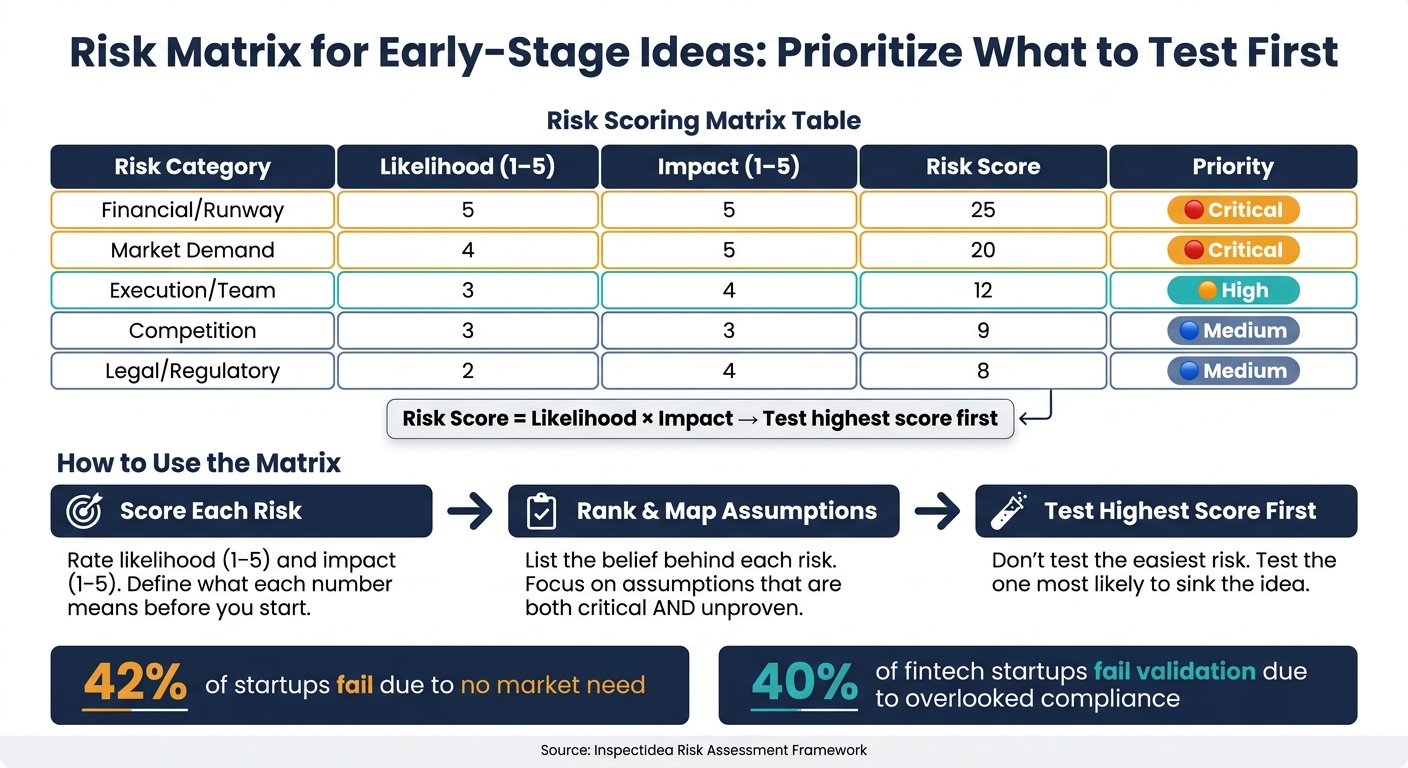 {Risk Matrix for Early-Stage Ideas: Prioritize What to Test First}
:::
{Risk Matrix for Early-Stage Ideas: Prioritize What to Test First}
:::
Once you've listed your main risk categories, the next job is figuring out what to test first. A lot of early-stage founders try to validate everything at the same time. That usually burns time and cash fast.
A more structured approach keeps you focused on the risks most likely to sink the idea early. Start with the highest-risk items, not the easiest ones.
Use a risk matrix to rank likelihood and impact
A risk matrix is a simple scoring tool. You rate each risk on two dimensions:
- how likely it is to happen (1–5)
- how much damage it would cause if it did (1–5)
Multiply those two numbers to get one risk score. The higher the score, the sooner you test it [6].
| Risk Category | Likelihood (1–5) | Impact (1–5) | Risk Score | Priority |
|---|---|---|---|---|
| Market Demand | 4 | 5 | 20 | Critical |
| Financial/Runway | 5 | 5 | 25 | Critical |
| Execution/Team | 3 | 4 | 12 | High |
| Competition | 3 | 3 | 9 | Medium |
| Legal/Regulatory | 2 | 4 | 8 | Medium |
Before you score anything, define what 1 and 5 mean. That part matters more than it may seem.
For instance, a "5" on likelihood might mean the risk is likely to show up within six months. A "5" on impact might mean it would cost you more than 20% of projected revenue. If everyone agrees on those definitions upfront, the scores stay consistent and more useful [6].
Once you've scored the top risks, the next step is to map the assumptions behind them.
Map assumptions by importance and uncertainty
A risk matrix shows what to deal with first. Assumption mapping shows why that risk is so high.
Every risk sits on top of a belief you haven't proved yet. Some of those beliefs are much more dangerous than others. That's where assumption mapping helps.
Write your core assumptions as plain, direct statements. For example:
"Small clinics will pay $299 per month for this tool"
"Users will sign up from a landing page without a sales call."
Then sort those assumptions on two axes:
- how critical the assumption is to your business model
- how uncertain it is right now
The assumptions in the top-right corner - critical and unproven - are your riskiest assumptions. Those should move to the front of your testing queue [5].
Put simply: test the assumptions that are both critical and unproven before the rest.
Track evidence in one place with InspectIdea
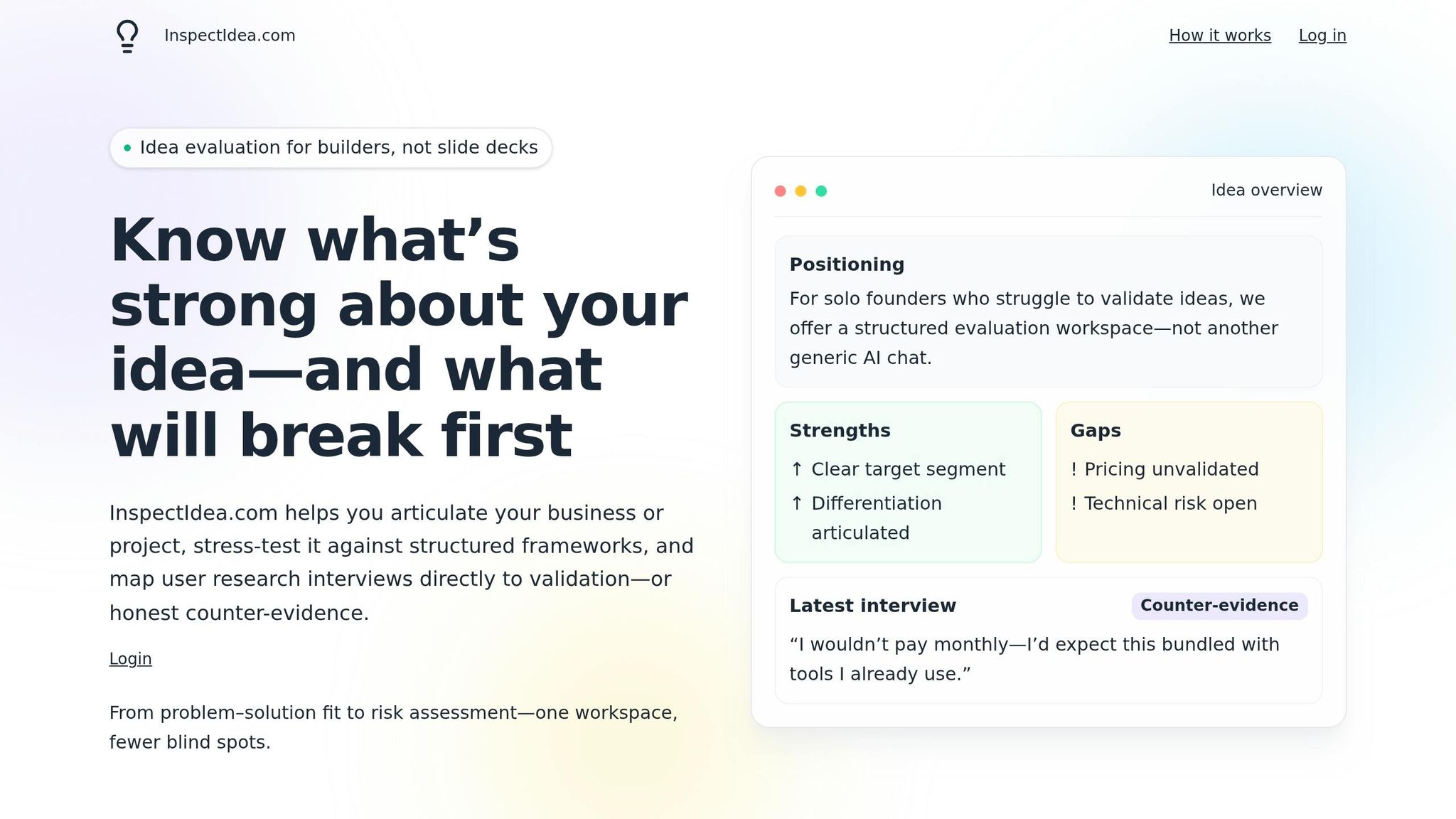
Risk scores don't mean much if they never change. As new evidence comes in, your rankings should change too.
InspectIdea gives you one place to log each test result against the assumption it supports or contradicts.
As you run interviews, smoke tests, or feasibility checks, update risk levels in real time. When the evidence shifts, the rankings should shift with it. Then you move the highest-risk assumptions into the next test.
InspectIdea's risk assessment covers market, competition, execution, regulation, and finances, so important gaps don't slip by as your idea changes.
Use those updated rankings to pick the cheapest test in the next section.
Tests That Reduce Risk Before Major Investment
Once you’ve ranked your riskiest assumptions, test the biggest one first. Start with conversations. Then move into tests based on what people do, not what they say.
Customer interviews and assumption-driven research
Customer interviews are the cheapest first step. But a lot of founders make the same mistake: they pitch instead of probe. That usually gets polite feedback, not proof.
A better move is to ask about past behavior. Questions like "How did you handle this the last time it came up?" or "What are you currently paying to deal with this?" get you closer to the truth. They show whether the problem is real and urgent.
If someone walks you through a messy workaround they’ve been using for months, that’s a strong signal. If they shrug and say "I'd probably use something like that," it isn’t.
Two signals matter most here:
- You hear the same pain come up again and again across different people.
- People are already spending something to deal with it, whether that’s money or time.
That’s usually how you tell whether the problem is a painkiller instead of a vitamin. Patterns often start to show up after 8 to 10 interviews, and 10 is a practical minimum [7].
Landing pages, smoke tests, and pre-sell experiments
If that same pain keeps showing up, the next step is to test commitment. A landing page or smoke test with a clear value proposition and a signup button shows whether people will take action, not just nod and smile. The point is to test willingness to act, not simple curiosity.
Set your success threshold before the test starts. For example: "At least 15% of visitors from paid traffic click the signup button." If you wait until after the results come in, it gets way too easy to explain away weak signals and call them wins [4].
Money is the strongest signal. Testing a $49 upfront payment for a product that doesn’t exist yet is a strong filter for real demand [3]. Pre-orders, Letters of Intent, and pilots work the same way. They ask people to put something on the line. And they’re low-cost to run [8].
Feasibility tests and manual delivery pilots
Once demand starts to look real, test whether you can actually deliver. A manual delivery pilot helps you answer that without building the product first.
You deliver the service by hand to a small group of real users. Maybe that means writing the report yourself. Maybe it means doing behind-the-scenes work that software would later handle. Either way, you learn what “done” actually looks like. You also run into edge cases that never show up in planning.
A mock-product setup goes one step further. Users interact with what looks like an automated product, but a human is doing the work behind the curtain. Both methods test two things at once: whether customers will use it and whether fulfillment works within your time and budget [4].
Decide Whether to Refine, Test Further, or Walk Away
After each test, stack the result against the success threshold you set before launch. Then use that evidence to decide what earns another round. The point isn't to ask, Did people seem to like it? It's to ask whether the result supports the assumption the test was built to check.
If you can't name three ways the idea could fail, there's a good chance you're protecting it instead of judging it.
"The most common experiment mistake is not designing a bad experiment - it's running an experiment without deciding what you'll do with the results." - Innovation Mode 2.0 [4]
Warning signs that the idea is weaker than it looks
Praise without action is not validation. Action matters more than interest. If people say they'd use it but don't sign up, don't pay, or don't refer anyone, that's a compliment - not a commitment. And interviews with friends, coworkers, or other warm contacts can throw you off fast.
A few patterns should make you pause. Maybe the problem sounds interesting, but no one is already spending money or time to fix it. Maybe customers treat it like a vitamin, not a painkiller. Or maybe the math only works if several best-case assumptions all come true at once. That's usually a sign the pain is shallow, sporadic, or too costly to solve at a profit.
A simple next-step framework for founders
Sort the result into one of three paths:
| Outcome | Decision | Next Step |
|---|---|---|
| Buyers sign up, pay, or book without prompting | Refine | Run a stronger test |
| Interest exists but commitment is weak or the offer is confusing | Test further | Change one major assumption - segment, problem, or offer - and re-test |
| Pain is shallow, sporadic, or too expensive to solve profitably | Walk away | Stop pursuing the idea |
If you pivot, change one variable only.
Also, document both sides: what supports the idea and what goes against it. That keeps you honest and makes the next decision a lot less fuzzy.
"The earlier you can kill a weak idea, the cheaper that lesson is." - Louis Corneloup, Founder at Dupple [2]
FAQs
::: faq
How do I find the riskiest assumption first?
Find the assumption most likely to kill your idea if it turns out to be false.
In most cases, that’s your biggest unknown. Maybe people don’t care enough about the problem. Maybe they won’t pay. Maybe they like the idea in theory but won’t change their habits in practice.
Say that core assumption in plain English. Then test it head-on with focused customer conversations or a simple pre-sell experiment.
Start with the one assumption that makes the whole idea fall apart if it’s wrong. :::
::: faq
What counts as real proof of demand?
Real proof of demand comes from actions, not just interest. The clearest signs are pre-orders, deposits, letters of intent, or time-limited trials that show people will spend time, effort, or money to get the solution.
Other helpful proof comes from actual behavior, like workarounds or manual processes, along with market signals such as search volume, community discussion, job postings, or crowdfunding activity. :::
::: faq
When should I stop testing and walk away?
Stop testing and move on when the last big questions can only be answered by actually building the product. Do the same when the evidence keeps pointing to the same hard truth: the core idea doesn’t hold up.
A few red flags tend to show up again and again:
- No clear buyer
- Weak pain
- No willingness to pay
- Distribution you can’t reach
- Economics that don’t work
At that point, more interviews, surveys, or small tests usually won’t change much. You’re not learning anything new - you’re just circling the same problem. :::