
How to Use Feedback to Refine Problem-Solution Fit
Most startups fail because they build something people don’t want. If I want a better problem-solution fit, I need to test four things early: is the problem real, is it urgent, does my approach help, and will anyone pay for it? The article’s core point is simple: feedback should test assumptions, not just collect opinions.
Here’s the short version:
- I start with a clear hypothesis: user, problem, timing, and expected result
- I use the lightest feedback method that can answer my next question
- I sort feedback into four buckets:
- problem existence
- urgency
- solution belief
- willingness to pay
- I look for behavior, not praise:
- demo requests
- workarounds
- repeat usage
- referrals
- pre-orders or LOIs
- I change segment, problem scope, feature set, or positioning based on what fails
A few numbers stand out. The piece notes that 10–20 interviews can be enough to spot patterns, 5–7 usability tests often surface major friction, and 40%+ on the Sean Ellis test can point to fit progress. It also points to a harsh stat: 42% of startups fail because they build products nobody wants.
If I had to reduce the whole article to one working rule, it would be this: write down the assumption, run the test, watch what users do, then change the smallest thing that fixes the weak signal.
How to Validate Your Startup Idea with Problem-Solution Fit
::: @iframe https://www.youtube.com/embed/F86_qn9CIzg :::
Set Up a Problem-Solution Hypothesis Before Collecting Feedback
Start with a hypothesis you can test: who the user is, what problem they have, why it matters right now, and what your solution should change. Writing this down does one simple but important job: it keeps feedback tied to clear assumptions instead of vague opinions. After that, you can test each assumption with the feedback method that fits it best.
Define the User, Problem, and Expected Outcome
The more specific your user definition is, the easier feedback is to read correctly. “Small business owners” is too broad. A sharper version looks more like: “remote product managers at 20–100-person SaaS companies coordinating sprint planning across multiple time zones.” That kind of detail shapes both the questions you ask and how you read the answers.
Your problem statement should spell out three things:
- who feels the pain
- what that pain looks like in their day-to-day workflow
- why it matters now
Look for strong pull signals. These are users who ask for demos, ask when the product will be ready, or already depend on spreadsheets, scripts, or contractors to patch over the gap [1][2][6].
Use a structured workspace like InspectIdea to document the customer, problem, solution, differentiation, and assumptions in one place.
List the Assumptions Feedback Needs to Test
Every hypothesis sits on top of assumptions. The point is to surface them before interviews, not after. A simple way to do that is to sort them into four groups, so each conversation has a clear job to do.
| Assumption Category | Key Question to Test | Success Signal |
|---|---|---|
| Problem existence | Is the pain severe and specific? | Users describe the same pain point without prompting [7] |
| Urgency | Are they actively trying to fix it now? | Evidence of manual workarounds or active searches [2][6] |
| Solution belief | Would this approach actually help? | Users ask for demos or specific edge-case functionality [1] |
| Willingness to pay | Is it worth the cost to them? | Users prepay or sign an LOI [1][7] |
Give each assumption a measurable signal, like repeated confirmation across interviews or a prepayment offer. Then use those assumptions to decide whether interviews, prototypes, or another test format will get you the answer fastest.
Choose the Right Feedback Methods for Your MVP or Prototype
::: @figure 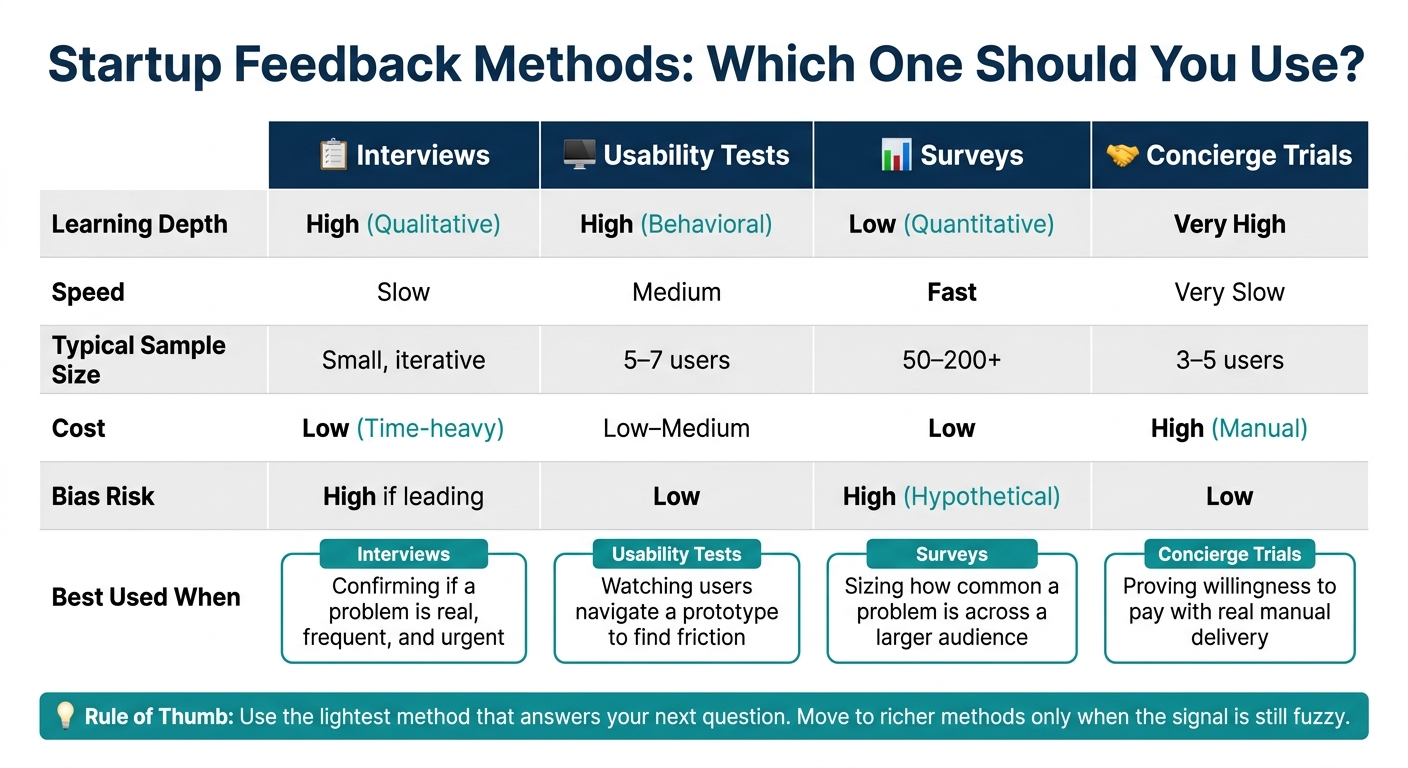 {Startup Feedback Methods Compared: Find Your Best Fit}
:::
{Startup Feedback Methods Compared: Find Your Best Fit}
:::
Once your assumptions are mapped out, the next step is simple: pick the method that gets you the fastest clear answer. Not every method fits every question. Use the wrong one, and you can burn time on feedback that sounds helpful but doesn’t push the product ahead. The better move is to match the method to the assumption you need to test first. What do you need to prove next?
Match Each Method to the Question You Need to Answer
Each method does a different job. Interviews help you test whether the problem exists and how urgent it is. Usability tests show whether people can use and trust the solution. Surveys help you see how common the problem is. Concierge trials test willingness to pay.
Customer interviews are usually the best starting point when you need to confirm that a problem is real, frequent, and urgent. They help you get at the why behind what people do, especially when you ask about past behavior instead of made-up future choices. Watch for pull signals like demo requests, launch questions, or prepayment offers [1][9][10].
Usability tests move the conversation away from opinions and toward actions. You watch real users try to complete tasks with your prototype. That’s where the truth tends to show up: where they pause, get lost, or quit. In many cases, 5 to 7 users is enough to surface most major friction points [8].
Surveys do something else well. They’re fast, easy to scale, and useful when you want to know whether a problem is common enough to merit more testing [9]. They won’t tell you much about deeper motives, but they can help you size the issue.
Concierge-style trials take the most work, but they can give you the strongest signal from actual behavior. You manually deliver the result your product would later automate, then watch whether users find it worth using in real conditions. Airbnb did this early with concierge-style listing photography and saw a sharp revenue lift. That’s a strong example of manual service proving the core value [3].
Compare Feedback Methods Before You Start
Before you spend time or money, tie your learning goal to the method that fits it best:
| Method | Learning Depth | Speed | Typical Sample | Cost | Bias Risk |
|---|---|---|---|---|---|
| Interviews | High (Qualitative) | Slow | Small, iterative sample [2] | Low (Time-heavy) | High (if leading) |
| Usability Tests | High (Behavioral) | Medium | 5–7 [8] | Low–Medium | Low |
| Surveys | Low (Quantitative) | Fast | 50–200+ [9] | Low | High (Hypothetical) |
| Concierge Trials | Very High | Very Slow | 3–5 [10] | High (Manual) | Low |
A good rule here: use the lightest method that can answer the question in front of you. If that answer still feels fuzzy, then move to a richer method. In practice, that often means starting with interviews, then shifting to usability tests or concierge trials once you have a prototype.
Turn Raw Feedback Into Clear Product Decisions
Raw feedback only helps if you sort it by the assumption behind it. After each interview or test, group your notes by what they support or challenge: problem existence, urgency, solution belief, or willingness to pay. That simple step turns a pile of comments into a clearer list of what needs to change first.
Collect Better Evidence With Structured Questions
Skip hypothetical questions. Ask things like, “Walk me through the last time this happened” or “What have you tried so far?” Those questions pull people out of guesswork and into actual behavior.
"Ideas are cheap. The proof is in commitments, not compliments." - Masoud Golchin, Backend Developer, Refact [5]
Use the same note-taking template in every session. Capture:
- when the problem started
- the current workaround
- the time or money cost
- exact quotes from the user
Ask users to rate problem severity on a 1–10 scale. Keep strong emotion and unprompted language separate from pain scores and task completion rates. That way, you’re not mixing what people feel with what they do.
Use InspectIdea to tag each note as support or challenge against the assumption it tests. This gives you a living record of what the evidence says.
Decide What to Change First
When the same pattern shows up again and again, trace it back to the assumption behind it. Tag each piece of evidence against the exact assumption it supports or challenges. Then mark that assumption as Validated, Invalidated, or Unclear before you decide what to change next.
Start with core fit problems. If the wrong customer segment is showing up in interviews, or the problem isn’t urgent enough to drive action, no amount of UI polish will save it. Forty-two percent of startups fail because they build products nobody wants [11]. Small usability fixes can wait until core fit is confirmed.
Compare Your Refinement Options and Their Tradeoffs
If the problem is real but not urgent, narrow the problem. If the wrong users are responding, change the segment. The failed assumption should point you to the smallest change that has a shot at fixing it.
| Refinement Option | Likely Benefit | Primary Risk | When to Choose |
|---|---|---|---|
| Narrow the Problem | Sharper value prop and higher urgency | Market size may shrink too much | When users have the problem but don't treat it as urgent |
| Change Target Segment | Finds users with real pain and existing workarounds | Requires restarting discovery from scratch | When feedback is contradictory or lukewarm |
| Simplify Feature Set | Faster build and less feature creep risk | May remove features users actually need | When users only engage with one part of the prototype |
| Adjust Positioning | Better conversion because the language matches user thinking | Can hide a real product gap if overused | When interviews are positive but sign-ups stay low |
Use the next feedback round to test whether the change improved the signal.
Measure Progress and Keep the Feedback Loop Running
Once you change a feature, segment, or message, run the test again against the same assumption and compare what users actually do [8]. That’s how you spot movement over time. The aim is simple: user signals should become steadier and more tied to a specific segment [1].
Use Simple Early Indicators of Fit
Focus on signals that get stronger or weaker after each round, not one-off compliments. As fit gets better, users move from polite interest to active pull [1][3]. You can see that shift in a few clear ways:
- Users describe the problem and solution in their own words, with no prompting.
- They stop using old workarounds and switch to your solution.
- They get frustrated when a feature is missing.
- They refer colleagues without being asked.
When those qualitative signals start to tighten up, add a simple numeric check. For surveys, 4.0/5.0 or higher on “Does this solve your problem?” and a 40%+ Sean Ellis result both point to meaningful fit progress [4].
Early feedback rounds often feel messy. One user loves it, another shrugs, a third wants something else entirely. That’s normal. As fit improves, those mixed signals should start to narrow, and the feedback should line up around the needs of one segment [1]. If it’s still all over the place after several rounds, the segment or the problem definition may need more work.
Key Takeaways for Refining Fit With Less Risk
If the signal keeps getting better, stay focused on the same assumption until you resolve it. Feedback should test assumptions, not confirm hopes. What matters most is what users do: pre-orders, continued usage, and unprompted referrals carry far more weight than what people say they might do someday.
"If you only test before launch, you do not have a loop. You have a one-off event." - Violetta Bonenkamp, Founder [8]
A structured feedback loop makes it easier to tell the difference between polite interest and real problem-solution fit. It also keeps the next decision tied to evidence instead of guesswork. InspectIdea can track which assumptions each round of feedback supports or weakens, so every round stays connected to the evidence.
FAQs
::: faq
What feedback method should I start with?
Start with direct, one-on-one customer interviews.
Before you build anything or make a pitch, put on your researcher hat. Don’t try to sell. Try to learn. The goal is to understand what people are doing right now and what they’ve done in the past, not what they say they might do for your idea.
Keep the conversation grounded in behavior. Ask what they do now, when they last ran into the problem, what part annoyed them most, and what they’ve already tried to fix it.
Tools like InspectIdea can help you sort those conversations and spot patterns in actual pain points. :::
::: faq
How do I know if a problem is urgent enough?
A problem is urgent when people can describe it in plain terms and are already spending time, money, or effort trying to deal with it. You want signs that the pain is real, not abstract. Things like lost hours, missed work, added risk, or repeated work are hard to ignore.
In interviews, focus on problems they ran into recently and are actively trying to fix. That matters. A small annoyance people tolerate is very different from a problem that pushes them to take action. If someone sounds interested but won’t pay, switch tools, or change how they work, the problem probably isn’t urgent enough. :::
::: faq
When should I pivot instead of keep refining?
Pivot instead of refining if your early validation gets fewer than 10 confirmations of the problem from your target segment. When the signals are mixed, refinement can still make sense. But if you’re seeing very little proof that the problem feels painful or worth fixing, your hypothesis is probably off target.
If customers still don’t see the value - or don’t care enough to switch - even after several rounds of changes, you’re likely working on the wrong problem. InspectIdea can help you test those assumptions early and spot gaps and risks. :::