Best Practices for Innovation Evaluation
Most teams don’t reject bad ideas well - they reject poorly documented ideas. If I want better calls, I need a clear review goal, a small set of scoring rules, evidence tied to each big assumption, and fixed decision points.
Here’s the short version:
- I define what decision I’m making first: screen, test, fund, defer, or stop.
- I use different criteria for different idea types instead of one scorecard for everything.
- I keep each idea in the same brief format so side-by-side review is easier.
- I score with a 1–5 rubric and written anchors, not gut feel.
- I check assumptions with the lowest-cost evidence that can answer the question.
- I review risk and upside together, not one without the other.
- I write down every gate decision so weak ideas don’t keep coming back.
- I use a review model that fits team size, pace, and budget.
One stat stands out: only 36% of organizations use defined criteria, while 44% still lean on partial or judgment-based decisions. That gap explains why teams waste time, miss better bets, and let politics shape funding.
If I had to reduce the whole article to one rule, it would be this: judge ideas by evidence quality and decision fit, not by enthusiasm.
How to Evaluate and Select the Best Ideas for Maximum Impact | Webinar
::: @iframe https://www.youtube.com/embed/eqx-_7z1qXA :::
Set the right foundation before scoring any idea
Once you've gathered the evidence, the next step is simple: make sure everyone scores ideas the same way. Before anyone assigns a score, line up the decision stage, the criteria, and the scoring scale. That way, reviewers aren't each using their own private rulebook. Define score anchors for every criterion so the rubric gets used the same way across the team. [3][4]
Define the evaluation objective and decision stage
Not every evaluation is trying to answer the same question. An early pass-fail review is mostly about one thing: is this idea worth looking at more closely? At that stage, the focus should be on learning speed and evidence gaps.
A later funding decision is different. Now you need deeper analysis around scalability, implementation risk, and financial value. The rigor should match the decision stage. As an idea moves ahead, the evidence should get deeper and the scoring should get tighter. [3][4]
Once the decision stage is clear, use a rubric that fits the level of uncertainty.
Choose criteria that match the idea type
A fixed scorecard tends to favor ideas that already come with neat numbers. As Lusidea notes, "A single ranked list favors more developed proposals because they have clearer numbers. Over time, that pattern narrows the pipeline and reduces the supply of new ideas." [3]
So don't force every idea through the same filter. Match the criteria to the kind of idea you're reviewing. Many teams begin with three core dimensions: customer value, technical feasibility, and business viability. From there, they may add strategic fit, differentiation, or testability when needed. Score incremental ideas on cost, demand, and complexity. Score transformational ideas on strategic fit, defensibility, and testability. [3][4]
| Idea Type | Key Criteria to Prioritize |
|---|---|
| Incremental (feature improvement) | Implementation cost, immediate demand, technical complexity |
| Transformational (new business model) | Long-term strategic fit, defensibility, testability of core assumptions |
Capture the basics in a consistent idea brief
Every idea should be documented in the same format. In plain terms, that means recording the target customer, the problem being solved, the proposed solution, how it differs from current options, its differentiator, key assumptions, and expected business impact. When each brief follows the same structure, ideas are much easier to compare before scoring starts.
InspectIdea uses structured fields to standardize this step across teams, so each submission arrives in a comparable format before the review begins.
With the brief in place, the next move is scoring and validation.
Use clear scoring methods and evidence-based validation
Once the idea brief is done, score the idea against a rubric and then test the assumptions behind it.
Build a scoring rubric that people can apply consistently
Use a simple 1–5 scale with written anchors: 5 = direct behavioral evidence, 3 = credible qualitative evidence, and 1 = assumption or gut feeling. That makes scoring more consistent across reviewers. [3]
Keep the rubric tight, with 5–7 criteria, and calibrate it before launch by scoring 2–3 sample ideas together. This helps teams spot scoring drift early. [3]
The weighting should shift based on the stage. Put more weight on strategic fit early on, evidence strength during validation, and feasibility plus financial viability at the funding stage. [3]
As a decision gets closer, evidence quality should matter more than first impressions.
| Method | Best Use Case | Advantages | Limitations |
|---|---|---|---|
| Simple Scorecard | Early-stage intake/screening | Fast, low barrier to entry | High subjectivity; lacks nuance |
| Weighted Scorecard | Mature programs with clear priorities | Aligns ideas with strategic goals | Requires upfront effort to define weights |
| Value-vs-Risk Matrix | Portfolio balancing and workshops | Visualizes trade-offs clearly | Hard to quantify "risk" early on |
| Opportunity Scoring (RICE/ICE) | Ranking backlogs or test candidates | Data-driven; "Confidence" factor rewards evidence | Requires reach and impact estimates |
Validate assumptions with customer and market evidence
Treat each core assumption as Validated, Untested, or Invalidated, and show that status in the score. [3]
The method should match the question you’re trying to answer. Use interviews for problem discovery, surveys for demand, and landing pages, concept tests, or prototypes for behavior. [5][2] Then update the score as the evidence changes. Weak evidence doesn’t mean the idea is dead. It usually means you need another test, not a final call. [3]
Compare evidence types by cost, speed, and reliability
Use the cheapest evidence that can answer the decision in front of you. That’s the key idea. Some methods tell you what people say. Others show what they do. And the cost difference can be big.
| Evidence Type | Use Case | Strengths | Limitations | Typical U.S. Cost |
|---|---|---|---|---|
| Qualitative Interviews | Problem discovery | Deep insights; uncovers "why" | Small sample; prone to bias | $500–$2,000 [3] |
| Quantitative Surveys | Market sizing/demand | Statistical significance; scalable | Measures what people say, not do | $1,000–$5,000 [3] |
| Behavioral Data (Pilots/MVPs) | Verifying actual usage | Most reliable; shows real action | Requires setup; narrow focus | $5,000–$10,000+ [3] |
| Financial Projections | Investment approval | Focuses on ROI and viability | Highly speculative at early stages | Internal labor [3] |
In practice, early-stage ideas need interviews and concept tests. Later-stage ideas need behavioral data and unit economics. If you push for costly evidence too soon, you burn time and money. If you lean on cheap evidence for too long, you miss key risks.
InspectIdea can link assumptions to research findings so scores stay current as evidence changes.
Design a repeatable process for decisions, risk, and governance
::: @figure 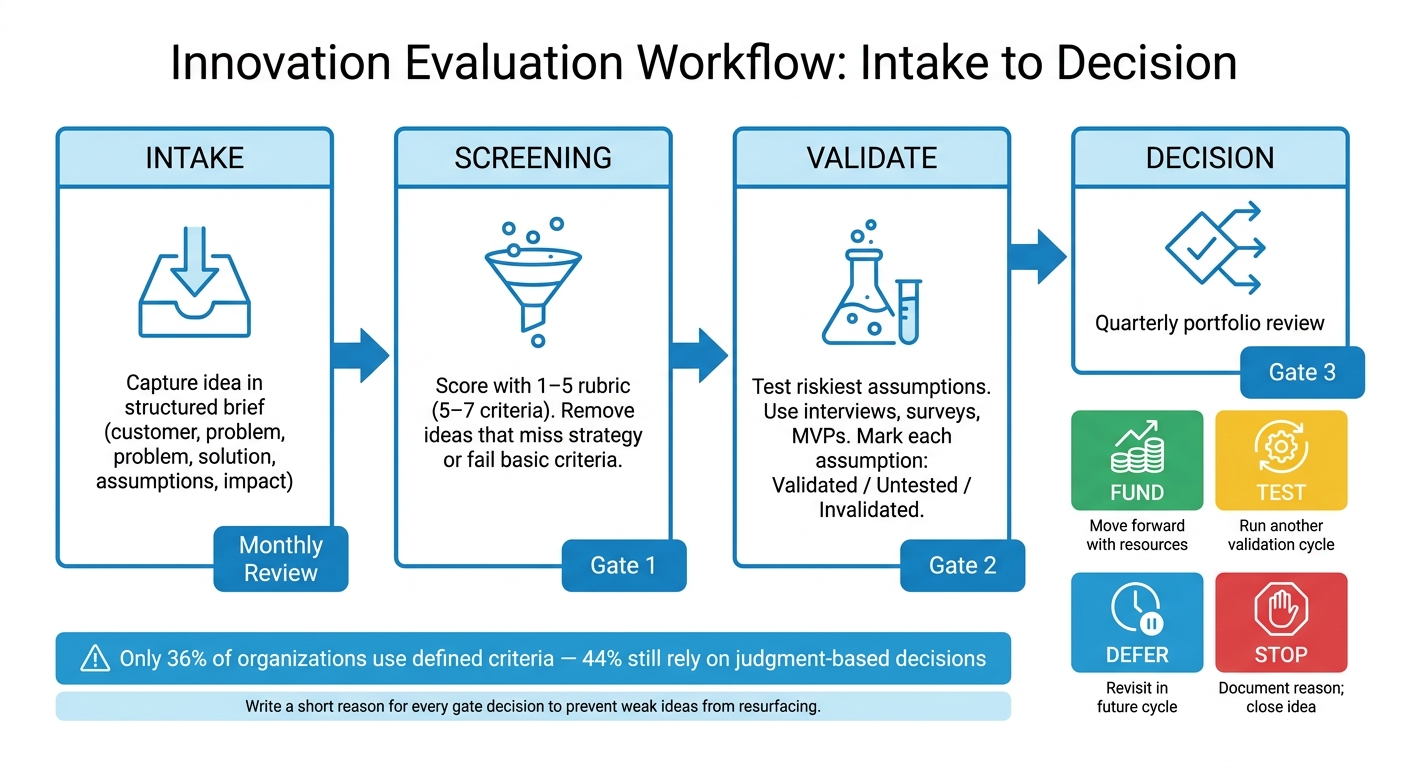 {Innovation Evaluation Process: From Intake to Decision}
:::
{Innovation Evaluation Process: From Intake to Decision}
:::
Scoring alone won’t get the job done. Once ideas have been scored and tested, you need a decision process that people can use again and again. The goal is simple: move ideas from submission to decision without losing discipline along the way.
Map the evaluation process from intake to decision
A repeatable innovation workflow usually moves through intake, screening, prototyping, and validation before a final decision [8][9]. Each stage should end with a gate: a clear decision point, not just another meeting or open-ended discussion [3][9]. If a gate doesn’t change funding or team capacity, it probably shouldn’t be there [8].
The screening stage removes ideas that don’t match your strategy or fail your basic criteria. From there, development and testing should focus on the riskiest assumptions before you put serious time or money into the idea. At the final gate, every idea should land in one of four buckets: Test, Fund, Defer, or Stop [3].
Keep a short written reason for every gate decision. That matters more than it sounds. If you record why an idea was rejected or stopped, you make future screening better and cut down on weak ideas popping up again a few months later [3][5].
In practice, a two-level review rhythm tends to work well:
- A monthly intake review to screen and route new submissions
- A quarterly portfolio review to look at capacity and resource use across active ideas [3]
Assess risk alongside upside
Once the gate structure is in place, review upside and downside at the same time. A lot of teams get excited by possible upside and give risk only a quick glance. That’s where bad bets slip through. A better way is to treat both as equal inputs.
For each idea, estimate upside based on likely revenue, cost savings, and scalability. Then pressure-test that estimate by looking at the probability of success and whether the team can actually execute [5][3].
Don’t just ask, “How big could this get?” Also ask, “How could this fail?” In many cases, scanning for failure modes tells you more than a rosy forecast ever will.
| Risk Category | Key Indicators | Evaluation Questions | Mitigation Actions |
|---|---|---|---|
| Market | Low demand, small TAM, weak switching motivation | Is this a painkiller or a vitamin? Why would customers switch? | Run user interviews; test with landing page pilots |
| Technology | Skills gap, infrastructure limits, complexity | Can we build this with current tools and team? | Build an MVP; conduct a technical feasibility spike |
| Execution | Resource scarcity, unclear ownership | Do we have the capacity and a clear owner? | Assign a dedicated lead; do capacity planning |
| Regulatory | Compliance hurdles, legal blockers | What legal or regulatory shifts could affect this? | Involve legal early; consider regulatory sandbox testing |
| Financial | High CAC, long payback, low LTV | Do unit economics work at scale? Is payback under 18 months? | Run financial modeling; use staged funding [1][6] |
Set stopping rules before work begins. These are specific conditions that tell the team when to halt an idea, such as target user behavior failing to show up after test cycles or costs running past an agreed range [3]. Without clear stop points, zombie projects can hang around far too long and eat up team time and budget.
Choose a governance model that fits team size and speed
Governance decides who reviews each gate and how fast decisions move. This isn’t about adding red tape. It’s about making sure the right people weigh in at the right moment, using the right facts.
| Model | Decision Speed | Consistency | Flexibility | Best-Fit Context |
|---|---|---|---|---|
| Centralized Review Board | Slower (scheduled meetings) | High | Low | Large enterprises; high-risk or high-capital projects |
| Business-Unit-Led | Fast | Low | High | Incremental improvements; decentralized teams |
| Hybrid Governance | Moderate | Moderate | High | Growing companies; fast-moving digital experiments |
For many growing teams, hybrid governance lands in the sweet spot. Big, costly, or more sensitive ideas move up to a central review. Smaller, incremental ideas stay with the business unit, where decisions can move faster.
One more thing: group decisions often drift toward the loudest person in the room. A simple fix is to use silent individual scoring before discussion starts. That helps cut down on seniority bias and gives quieter reviewers a fair shot to shape the outcome.
InspectIdea can support this kind of governance by keeping a record of evaluations, research findings, identified strengths, weak areas, and risks. That way, review meetings rely on a documented audit trail instead of whoever happens to remember the most [3][7].
Conclusion: The core practices that make innovation evaluation reliable
Innovation evaluation breaks down when teams go with gut feel instead of a clear process. Only 36% of organizations use defined criteria, while 44% rely on partial or judgment-based decisions [3]. That’s where good ideas can quietly get cut, and weak ones can move ahead and burn time, money, and team energy.
In practice, these habits work best together: define the objective, match criteria to the idea stage, use a calibrated rubric, validate assumptions with evidence, and weigh risk alongside upside.
Evaluate as an auditor, not an advocate: look for failure modes and evidence gaps [6].
A repeatable governance process holds the whole thing in place. If decision rights are fuzzy, reviews happen sporadically, or no one writes down why an idea was funded or stopped, even a strong scoring rubric starts to lose weight. Written records make later screening sharper and more consistent [3][1].
InspectIdea gives teams a structured workspace to capture ideas, test assumptions, and document decisions.
FAQs
::: faq
How do I choose the right review stage for an idea?
Choose the review stage that matches the idea’s maturity, the level of uncertainty around it, and the decision in front of you. In plain terms: are you checking for strategic fit, validating a problem, proving feasibility, or getting ready to scale?
InspectIdea can help by giving you a structured workspace to sort through the idea, use proven frameworks, pressure-test the concept, and validate assumptions through user research. :::
::: faq
What evidence should I collect first?
Start by identifying and mapping the assumptions behind your idea before you jump into raw data collection. Think of the evaluation like an audit: the goal is to spot weak points, hidden risks, and gaps that could cause trouble later.
Next, sort those assumptions by risk and uncertainty. Focus on the ones that score high on both first. That way, you can find major flaws early and avoid wasting time, effort, and money on something built on shaky ground. :::
::: faq
How can I stop bias from affecting idea scores?
Use a data-informed, repeatable process instead of relying on gut feelings. One simple way to do that is to have people score ideas anonymously. That cuts down on social pressure and makes it easier to judge the idea itself, not the person behind it.
A structured framework also helps. Stick to five or six clear criteria so everyone is judging ideas the same way. Without that kind of structure, teams often drift into inconsistent calls and vague debates.
It also helps to score ideas across separate dimensions, such as feasibility, impact, and evidence strength. That gives you a cleaner picture. An idea might sound promising but be hard to execute. Another might be easy to ship but have weak support behind it.
Tools like InspectIdea can help make the process more open by testing assumptions and tying decisions back to research. :::