
7 Costly Mistakes to Avoid When Evaluating Ideas
Most bad ideas don’t fail at launch. They fail much earlier - when people mistake hope for proof.
If I were judging a new idea, I’d keep it simple: talk to strangers in the target market, test whether they’ll pay, check what they use now, score the idea with the same rules each time, and set a clear go/no-go bar before testing starts. That matters because 42% of startups fail from no market need. And a short validation cycle can save months of building the wrong thing.
Here’s the full list of mistakes to avoid:
- Relying on assumptions instead of customer interviews
- Confusing enthusiasm with market demand
- Ignoring competition and current alternatives
- Skipping pricing and willingness-to-pay tests
- Using vague judgment instead of a scoring system
- Missing build, team, legal, and delivery risks
- Failing to set clear test thresholds and decision rules
My takeaway: Don’t ask whether an idea sounds good. Ask how it can fail, then test that first. Look for actions like deposits, pre-orders, booked calls, or signed LOIs - not praise, likes, or “keep me posted.”
::: @figure 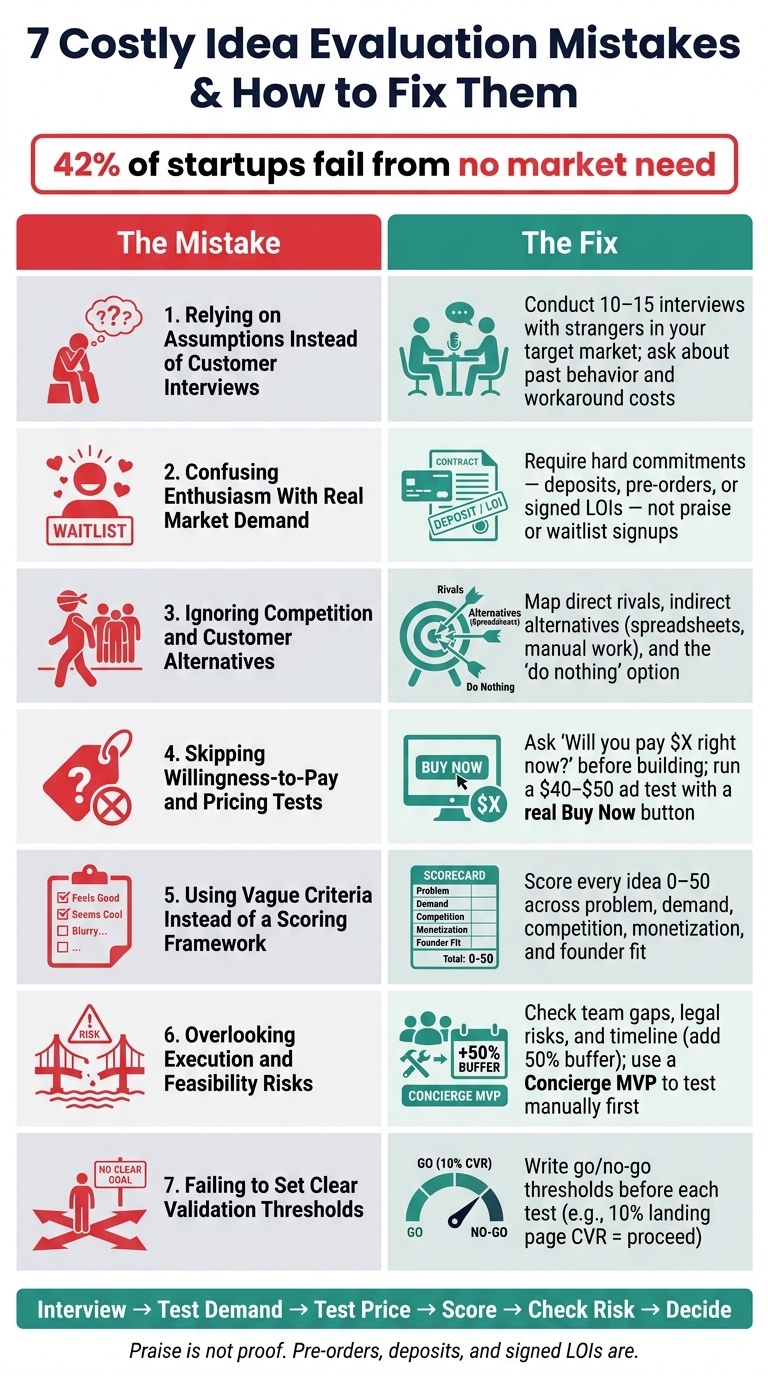 {7 Costly Idea Evaluation Mistakes (And How to Fix Them)}
:::
{7 Costly Idea Evaluation Mistakes (And How to Fix Them)}
:::
Stop Building. Start Validating | The #1 Mistake New Founders Make
::: @iframe https://www.youtube.com/embed/dpWCXod6Klc :::
Quick Comparison
| Mistake | What goes wrong | What I’d do instead |
|---|---|---|
| Assumptions over interviews | I trust my own story | I ask 10–15 target customers about past behavior |
| Enthusiasm over demand | I treat praise as proof | I test for payment or other hard commitment |
| Ignoring alternatives | I miss the status quo | I study current tools, manual work, and “do nothing” |
| No pricing test | I build before checking price | I test a real offer with a real price |
| No scorecard | I judge ideas by feel | I use one scoring model for every idea |
| No feasibility check | I miss team, legal, or tech gaps | I list failure modes and test them early |
| No decision rules | I move the goalposts | I write pass/fail thresholds before each test |
If I want to spend less money on weak ideas, this is the path I’d follow: interview, test demand, test price, score, check risk, then decide.
What Good Idea Evaluation Looks Like
Good idea evaluation has three traits: it’s evidence-based, repeatable, and decision-oriented. In plain English, that means you’re not leaning on gut feel or rounding up opinions from friends, family, or supporters. You’re collecting actual data, using the same process each time, and making a clear call at every stage.
There’s an important difference here. An assumption is something you believe internally. A signal is indirect interest. Validation is a real commitment, like a deposit, pre-order, or signed LOI. That’s why behavior matters more than opinions. Look at what people do: clicks, deposits, pre-orders, and signed commitments.
A solid process usually looks like this: define a specific customer and problem, interview that customer, test demand on a small budget, compare alternatives, test pricing, score the idea, map the risks, and then decide whether to refine it, test again, or reject it.
Strong evaluators don’t act like cheerleaders for the idea. They act more like auditors, trying to spot the exact reasons it could fail [1]. That contrast shows up clearly below:
| Weak Evaluation | Strong Evaluation | |
|---|---|---|
| Source of truth | Gut feeling, friends, family | Strangers in the target audience [2] |
| Data type | Qualitative "interest" and surveys | Behavioral intent and financial commitment [6] |
| Process | Build the MVP first | Test the riskiest assumption first [3] |
| Goal | Confirm the idea is good | Discover where the idea might be wrong [1] |
Next, avoid the first trap: treating assumptions as evidence.
1. Relying on Assumptions Instead of Customer Interviews
A lot of founders don't test an idea. They try to prove they're right.
That's where things go sideways. Confirmation bias and selective attention make it easy to notice only the signals that fit your story. And friends or coworkers? Most won't give blunt feedback. They'll give polite support.
The gap between what people say and what they do is a big deal. 42% of startups fail because they build something with no market need [1]. That's why you need to talk to actual target customers, not just people in your circle.
A good starting point is 10–15 customer interviews. Ask about:
- past behavior
- current workarounds
- what those workarounds cost
This matters because behavior tells the truth better than opinions do. If people aren't already spending time or money to deal with the problem, the pain probably isn't that strong.
Once interviews show there's a real problem, the next step is to see whether interest turns into something measurable.
| Evidence Type | Weak Signal | Strong Signal |
|---|---|---|
| Source | Friends, family, or peers | Strangers matching your target customer profile |
| Feedback | Friendly agreement | Direct request to sign up for the beta |
| Current behavior | Paying for spreadsheets or manual processes | Pre-payment, deposit, or Letter of Intent (LOI) |
| Commitment | Email signup or social media engagement | Pre-payment, deposit, or Letter of Intent (LOI) |
| Question type | Questions about past behavior | Questions about past behavior and cost of workarounds |
Interviews help you find the problem. The next trap is taking polite interest as proof of demand.
2. Confusing Enthusiasm With Real Market Demand
Once interviews show the problem is real, the next step is simple: find out whether people who don’t know you will pay for a fix.
That’s where a lot of founders get tripped up. Enthusiasm helps, but it doesn’t prove much. Interviews show the problem exists. Demand tests show whether there’s an actual market.
People say they’d buy all the time. Far fewer pull out a card, sign paperwork, or send money. Even people who mean well often overstate intent [5].
So don’t stop at kind words. Look for real commitment:
- a deposit
- a pre-order
- a signed LOI
Then push one step further. Is the problem urgent enough that people are already hunting for a way to solve it? That’s the part that matters.
Buffer did this well. The company checked demand with a two-page landing page that showed pricing and got its first paying customer in four days [8].
| Signal | What It Usually Means | Demand Strength |
|---|---|---|
| Polite praise like "keep me posted" | Courtesy, not commitment | Very Low |
| Waitlist signup | Curiosity | Low to Medium |
| Pre-order deposit or credit card on file | Willingness to pay | High |
| Signed Letter of Intent (LOI) | Buyer intent | Very High |
Next, compare that demand with the alternatives customers already use.
3. Ignoring Competition and Customer Alternatives
Once demand looks real, the next step is simple: what are customers using now?
A lot of founders look only at direct rivals. But competition is usually much broader. It can be spreadsheets, manual processes, internal scripts, agencies, or the plain old choice to do nothing. And that last option, the status quo, is often the toughest one in the room.
The better question is not whether someone would use your product. Ask how they solve the problem today. That gets you actual behavior instead of guesswork [5][3]. If they can't point to a recent pain point, odds are low that they'll switch.
Two checks help here: the urgency test and the copyability test.
The urgency test asks whether the problem hurts enough that people are already looking for a fix right now. The copyability test asks whether an established rival could copy your main differentiator in a single development sprint. If the answer is yes, the idea probably doesn't have enough protection to hold up [1].
On the research side, three-star reviews on G2 or Capterra are gold. They often show what's fine but still frustrating: missing features, switching friction, and needs that still aren't being met. That's often where a new entrant can find room to move [4].
Competitors don't kill an idea by themselves. In many cases, they prove demand exists. The real issue is whether you can win.
| Competitor Type | What to Look For | Where to Find It |
|---|---|---|
| Direct Competitors | Pricing, positioning, feature gaps, 1-star/3-star reviews | G2, Capterra, App Store, Product Hunt |
| Indirect Alternatives | Manual workflows, spreadsheet usage, workaround costs | Customer interviews, Reddit, industry Slack groups |
| The "Do Nothing" Option | Switching costs, data migration risk, habit inertia, lack of urgency | "Current state" interviews, urgency tests |
| Market Demand Signals | Search volume for the problem, job postings for manual roles | Google Keyword Planner, LinkedIn Jobs, Quora |
If customers already have alternatives, the next thing to find out is whether they'll pay to switch.
4. Skipping Willingness-to-Pay and Pricing Tests
If customers already have other options, the next step is simple: will they pay enough to switch? A problem isn't validated until someone parts with money to solve it. This is where a lot of founders get burned. They hear strong interest, build the product, launch it, and then find out that "I'd definitely use this" doesn't turn into sales.
Test a clear price before you build. Don't ask, "Would you pay for this?" Ask, "Will you pay $20 right now for early access?" That wording changes everything. If 3 out of 10 strangers pay on the spot, that's a very strong signal [2]. If people like the idea but won't commit money, you're likely dealing with a pricing issue, not just low demand.
If you want a faster read, run a $40–$50 ad test over 3 days. Send Google or Meta traffic to a landing page with a real Pre-order or Buy Now button. Then use the results below to judge whether the price test passes.
| Metric | Move Forward | Refine or Reject |
|---|---|---|
| Ad Click-Through Rate (CTR) | Above 2% | Below 1% |
| Cost Per Click (CPC) | Under $3 | High costs relative to LTV |
| Landing Page Conversion | Above 3% (ads) / 5% (organic) | Below 2% |
| Cold Outreach Close Rate | 3 out of 10 strangers paying on the spot | Very low or no immediate payment |
| Unit Economics Margin | Positive (Revenue > Delivery + CAC) | Negative (losing money per sale) |
| Payback Period | Under 12 months | Over 18 months |
Before you move ahead, do a basic unit economics check: revenue − delivery cost − CAC. If that number is negative, the idea has a structural problem that enthusiasm won't solve. Even modest retention can support a viable CAC, but only when the math holds up. Payback period matters too. If it takes more than 18 months for revenue to cover acquisition cost, the model gets capital-intensive fast [2]. The idea only moves ahead if the price covers both delivery and acquisition.
5. Using Vague Criteria Instead of a Scoring Framework
Once pricing shows people are willing to pay, rate the rest of the idea using the same framework every time. That's the key. A good story can feel like proof when the data is weak. And without a defined scoring system, you’re not auditing the idea - you’re defending it.
Use the same inputs for every idea: problem, demand, competition, monetization, and founder fit. Each one should connect back to evidence you already gathered from earlier tests, like interviews, demand checks, competition research, and pricing results. Does the problem come up every week? Is search demand active? Do competitor reviews show the same gaps again and again? Can the business make money soon? Do you have direct experience or access to distribution?
Give each signal a 0 or 1 based on evidence, then total the score.
A simple 50-point framework turns those signals into a clear call [9]:
| Score (out of 50) | Verdict | Action |
|---|---|---|
| 40–50 | Strong Validation | Build the MVP |
| 30–39 | Promising | Fix weak categories first |
| 20–29 | Risky | Pivot the angle or narrow the niche |
| Below 20 | Not Ready | Move on to a new idea |
A scorecard turns a hunch into a decision, but execution risk still has to clear the next test.
6. Overlooking Execution and Feasibility Risks
A high-scoring idea can still fall apart once you try to build and sell it. That’s why feasibility comes next.
Start with a plain resource check. Look for missing skills, cash, tools, partners, or access to the market. Any one of those gaps can sink the idea. The main trouble spots are usually team gaps, technical complexity, operational dependencies, and compliance risk. These are the build risks that can derail an idea that looks great on paper.
If you're working in a regulated market like fintech or cybersecurity, do a quick compliance check early. That can be as simple as mock filings or short interviews with advisors. Ask "Can we sell this legally?" before "Can we build it?". That’s just basic due diligence.
Timeline estimates cause trouble too. Startup timelines are often 40% to 50% too optimistic [1], so add a 50% buffer.
One of the fastest ways to test feasibility is to do the work by hand first. Use a Concierge MVP to deliver the promise manually before you automate anything. Manual delivery gives you a clear read on whether the idea works before you spend time and money on automation.
It also helps to run a failure-mode scan. Write down the top risks that could kill the idea. Then use that scan as a final feasibility gate before moving ahead. If the idea can’t survive that test, it’s not ready.
7. Failing to Set Clear Validation Thresholds and Decision Rules
If you don't set success criteria before a test starts, testing turns into expensive noise. Teams either test forever or move ahead on shaky signals.
The main issue is moving the goalposts after the data comes in. If you haven't written down what success looks like in advance, it's easy to explain away weak results. That's where theory-induced blindness kicks in: once you're sold on an idea, you start filtering out evidence that says it's not working.
A simple fix is to write a one-page test brief before each experiment. Keep it tight:
- hypothesis
- audience
- metric
- go/no-go threshold
For example: "If 10% of landing page visitors book a discovery call, we build a clickable mockup." That kind of rule keeps validation grounded in action, not gut feel.
You can also use test-specific gates, like 15 interviews, 100 landing-page signups, or a pre-order target. For A/B tests, a minimum of 100 conversions per variant is often needed to reach 95% statistical confidence [3]. Those thresholds give you a clear way to decide if the idea should move forward, change, or stop.
Use the same three outcomes for every test:
| Decision | Evidence Pattern | Action |
|---|---|---|
| Persevere | Target customers describe the same painful problem unprompted and take a high-commitment next step, such as paying or signing an LOI. | Run the next stronger test, such as moving from a landing page to a pre-sale. |
| Pivot | Interest exists, but commitment is weak, or customers differ widely on the primary use case. | Change one major assumption - segment, problem, or offer - and retest. |
| Kill | Customers praise the idea but cannot name a recent example of the pain or a reason to act now. | Stop building and save runway for a different idea. |
There's another trap here too: indefinite testing. At some point, you have to stop asking whether the problem is real and start deciding what to build. When the question shifts from problem to feature, validation should give way to execution.
That matters because two weeks of rigorous validation can save roughly 6 months of building the wrong product [5]. Set the stopping point before you begin, then stick to it.
With the rules in place, the next move is to use simple tools to apply them the same way every time.
Practical Tools to Evaluate Ideas More Objectively
If you want to stop judging ideas on gut feel, you need a process. Structured tools help you do that. Each one checks a different part of the idea: the problem, demand, other options, pricing, fit, risk, and market size.
Used in order, these tools keep you from running the same test again and again. Once a tool gives you a pass signal, move to the next gate.
| Tool | Purpose | Pass Signal |
|---|---|---|
| Customer Interview Guide | Is the problem real and urgent? | 5+ people who have tried to solve the pain in the last 30 days [7] |
| Research Log | What are customers doing today instead? | Clear workarounds or spending on imperfect alternatives [2][3] |
| Lean Experiment Template | Does your hypothesis hold under real conditions? | The pre-committed metric is hit before the test ends [4][3] |
| Pricing Experiment Matrix | Will people actually pay? | A pre-order deposit, Stripe payment, or booked calendar slot [7] |
| Scoring Model | How does this idea compare objectively? | An Opportunity Score that weighs problem quality, solution quality, and feasibility [4] |
| Risk Grid | What could kill this? | Identify at least 3 failure modes and assign each one a test or owner [1][4] |
| TAM/SAM/SOM Estimate | Is the market big enough to matter? | Use bottom-up sizing: reachable customers × price × realistic capture rate [1][5] |
For market sizing, skip flattering top-down numbers. A bottom-up calculation gives you a figure you can defend [1]. It’s much closer to how the market works in practice: how many people you can reach, what they might pay, and what share you can win.
In the U.S., founders can also sanity-check those assumptions with SBA Business Guides and IRS Schedule C data to get more grounded revenue benchmarks for their category [5].
And one more thing: praise is not proof. Someone saying, “That’s a great idea,” doesn’t mean they’ll pay. Pre-orders, booked calls, and cards on file are stronger signals. That’s the difference between polite interest and actual demand.
When you run these tools in sequence and set clear thresholds ahead of time, you turn idea evaluation from an expensive guess into a more disciplined process. The next section looks at how to make that process easier to use with visual, standardized outputs.
Tables and Visuals to Make the Advice Actionable
The tables below turn the tools above into simple pass/fail checks. Use them to judge four things: competition, pricing, scoring, and decision rules. That makes it easier to see if you should refine the idea, run another test, or stop.
Competitor Comparison & Differentiation Matrix
Start by looking at competitors and substitutes. That includes manual workarounds and doing nothing at all.
| Competitor/Alternative | Target Segment | Key Pain Points | Pricing Model | Your Differentiation (one-sprint test) |
|---|---|---|---|---|
| Incumbent SaaS | Enterprise | High complexity, slow support | $500+/mo | Simplified UI; 2-click workflow |
| Spreadsheets/Manual | SMB/Solo | Human error, time-consuming | Free/$0 | Automated sync; 5 hrs saved/week |
| Niche Competitor | Specialized | Lacks mobile integration | $49/mo | Native iOS/Android app |
| "Do Nothing" | All segments | Problem persists, lost revenue | $0 (hidden cost) | Immediate ROI via automation |
This table gives you a clean side-by-side view. If your idea only looks a little better than what people already use, that's a warning sign. If the gap is obvious in one sprint, you've got something worth testing.
Pricing Test Table
Use this table to turn willingness-to-pay into a measured test. Track clicks and deposits at each price point.
| Price Point (USD/mo) | Target: Click-to-Purchase | Target: Email Signup | Decision |
|---|---|---|---|
| $49 (Starter) | >15% | >30% | High demand - persevere |
| $99 (Pro) | 5%–10% | 15%–20% | Moderate - iterate on offer |
| $199 (Premium) | <3% | <10% | Low demand - re-evaluate or kill |
Pricing tests help cut through polite feedback. Someone saying, “I’d use this,” is nice. Someone clicking or leaving a deposit is much more useful.
Idea Scoring Matrix
Once the raw signals are in, score the idea with one framework. Use this only after you have interview, demand, and pricing data.
| Dimension | Score (0–10) | Evidence Notes | Risk Level |
|---|---|---|---|
| Problem Severity | 9 | Customers spending $500/mo on workarounds | Low |
| Market Size (SAM) | 6 | $200M niche; bottom-up calc verified | Medium |
| Differentiation | 4 | Core feature replicable by incumbents | High |
| Feasibility | 8 | Team has 10+ years of domain expertise | Low |
A scoring matrix like this keeps you from judging the idea on gut feel alone. One strong signal doesn't erase a weak one. For example, a painful problem and strong team may still not be enough if incumbents can copy the core feature with ease.
Decision Rules Table
Lock the decision rule before you run the test. Set thresholds before the test starts.
| Signal Source | Persevere ("Go") | Pivot | Kill ("No-Go") |
|---|---|---|---|
| Landing Page CVR | >10% | 3%–9% | <3% |
| Pre-Sales / Commitment | 10%+ of signups pay | High interest, no pay | 0 sales |
| Customer Interviews | 15+ confirming "Must-Have" pain | Mixed signals on pain severity | Most say "Nice-to-Have" |
| Market Size (SOM) | >$1M | $250K–$1M | <$250K |
This is where the whole process gets sharper. You decide the bar before results come in, so you don't move the goalposts later. That's a small step, but it saves a lot of wasted time.
Conclusion
All seven mistakes point to the same issue: letting hope stand in for proof.
That move - from opinion to evidence - is what turns evaluation into a real decision process. The fix isn’t fancy. Use evidence before commitment. Talk to real customers. Run low-cost tests before you sink serious time or money into the idea. Score it across problem, demand, competition, pricing, feasibility, and risk. Set your go/no-go thresholds before the results come in. Then switch from advocate to auditor so you can spot blind spots early. Put together, these checks help stop weak ideas from eating up time and capital.
The tools are already on the table: structured interviews, scoring matrices, pricing tests, competitive analysis, and clear decision rules built around one outcome - interview, test, score, set thresholds, then decide whether to refine, test again, or reject. They won’t guarantee success. But they will expose weak ideas early and help save runway.
FAQs
::: faq
How many customer interviews are enough?
Typically, 10–15 customer interviews are enough to validate a problem. That’s often enough to spot real pain points and repeated patterns.
In most cases, this gives you what you need without slowing the work down or using extra time and resources. :::
::: faq
What counts as real validation?
Real validation means having proof that a specific group of people will pay a specific price to solve a specific problem in the exact way you plan to offer it before you build the product.
The signals that matter most are concrete ones: deposits, pre-orders, or credit card commitments. :::
::: faq
When should I kill an idea?
Kill an idea when your evaluation shows it probably won’t work.
A few signs usually make that clear:
- You’ve found failure points you can’t fix
- Target customers seem indifferent or don’t feel much pain
- Tests show your core assumptions are wrong
If the idea can’t meet the success criteria that matter, or it falls apart under real-world scrutiny, that’s a strong sign to stop putting time and money into it. :::