
How to Identify Blind Spots in Your Business Idea
Most business ideas fail because of hidden assumptions or "blind spots" that founders overlook. These blind spots can lead to wasted time, money, and effort on solutions nobody wants. To avoid this, focus on:
- Clarifying assumptions about your customers, their problems, and your solution.
- Testing differentiation: Is your idea truly hard to replicate? Does it solve an urgent problem?
- Validating customer insights: Talk directly to potential users and challenge your beliefs with real feedback.
- Stress-testing your business model: Ensure pricing, acquisition, and retention plans are realistic and scalable.
- Identifying risks: Use frameworks to prioritize and address the most critical challenges.
Start by identifying and testing the assumptions driving your idea. Then refine your approach based on evidence, not optimism. The goal? Reduce uncertainty and ensure your idea solves real problems effectively.
::: @figure 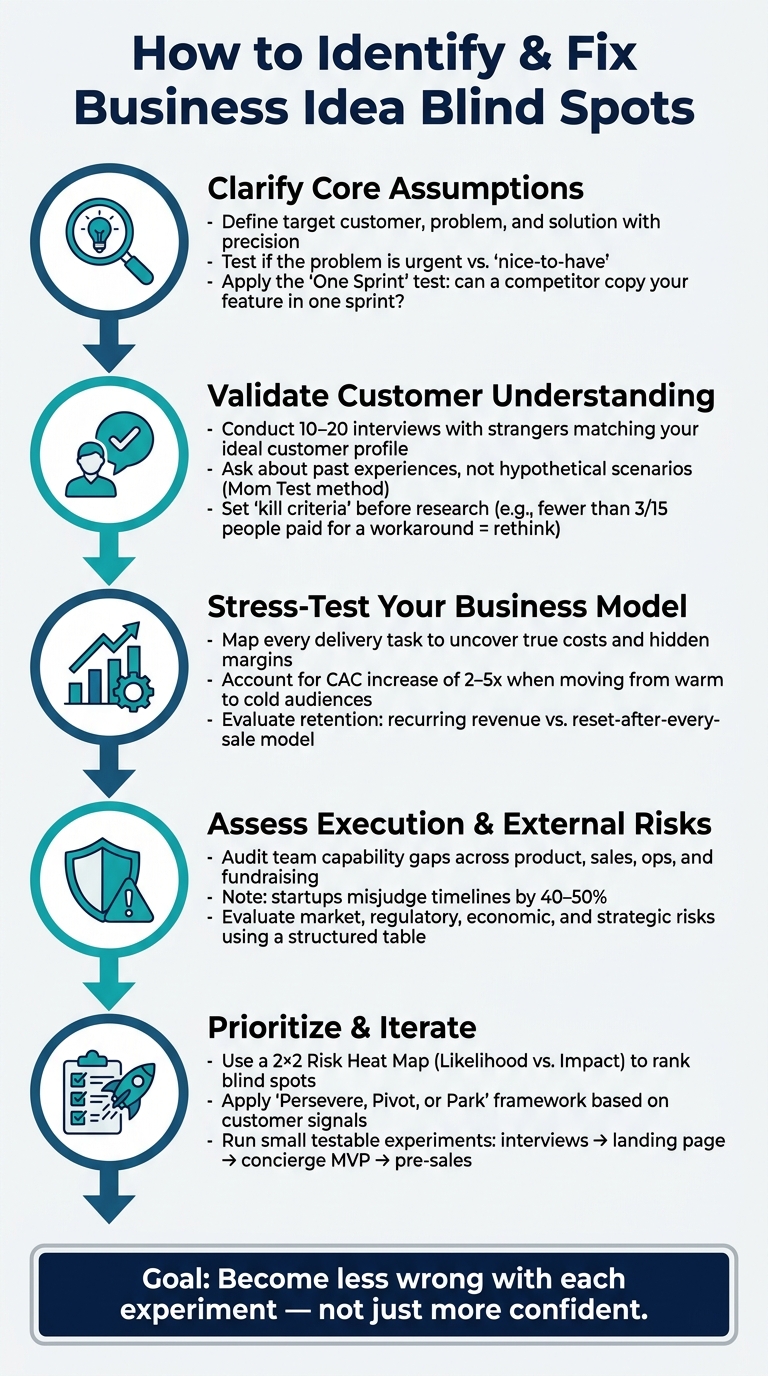 {How to Identify & Fix Business Idea Blind Spots}
:::
{How to Identify & Fix Business Idea Blind Spots}
:::
Instantly Exposes Flaws in Your Business Ideas
::: @iframe https://www.youtube.com/embed/s_fwhRCVXIo :::
Clarify Your Core Assumptions
Every business idea is built on a set of beliefs - often untested and undocumented. When these assumptions go unexamined, they can create blind spots that may derail your progress.
Define Your Target Customer, Problem, and Solution
The first step to uncovering potential vulnerabilities in your idea is to clarify your assumptions. Start by clearly defining three key elements: who your target customer is, what problem they face, and how your solution addresses that problem. Be as specific as possible. For example, "small businesses" is too broad to be actionable. A better definition might be: "restaurants with 20–50 employees that still rely on paper for scheduling." This level of precision helps you identify and challenge weak assumptions.
Once you've outlined these elements, validate each one. For the problem, ask yourself if it represents an urgent need or merely a "nice-to-have" improvement. Urgent needs prompt customers to actively seek solutions, while "nice-to-have" features are unlikely to drive immediate action. Identifying the latter can reveal critical blind spots that need attention early on.
When evaluating your solution, focus on what motivates customers to switch. It's not enough for your solution to be better; it must compel action despite the costs of switching, such as time, learning new systems, or disrupting workflows. If you can’t explain why someone would make the switch right now, it’s a sign that your solution assumption might be shaky.
After defining and validating these specifics, take a step back to assess whether your assumptions genuinely differentiate your idea in the market.
Check Your Assumptions About Differentiation and Market Fit
Testing your assumptions doesn’t just clarify your target - it also helps you determine whether there’s real demand for your product. Differentiation is one area where founders often mislead themselves. While it’s easy to believe your idea is unique, proving that this uniqueness matters to buyers - and can withstand competition - is much harder.
A quick way to test your differentiation is the "One Sprint" test: could a well-funded competitor replicate your core feature in a single development sprint? [1] If the answer is yes, your differentiation likely won’t hold up. Sustainable differentiation in today’s market requires something more difficult to copy, such as a deep focus on a niche, a proprietary process, earned trust, or exclusive access that competitors can’t easily replicate.
When it comes to market fit, be cautious about confusing interest with demand. Hearing "that’s a great idea" is nice, but it’s weak evidence. Stronger proof comes from observing people already spending money to solve the same problem. As Daniel Kahneman aptly stated:
"The confidence that individuals have in their beliefs depends mostly on the quality of the story they can tell about what they see." [1]
In other words, a great story about your idea can mask the lack of tangible evidence. To avoid this trap, turn each assumption into a testable hypothesis. For example: "Restaurants with 20–50 employees will pay $X/month to eliminate paper scheduling because it wastes Y hours per week." This approach forces you to find real evidence instead of relying on a compelling narrative. Tools like InspectIdea can help you articulate and test these assumptions systematically.
Validate Your Understanding of the Customer
Once you've clarified your assumptions, the next step is to test them directly with potential customers. This is where many founders slip up - they skip direct conversations in favor of secondhand insights, like industry reports or encouragement from friends. But to truly validate your ideas, you need to connect with real customers and hear their perspectives firsthand.
Conduct User Research
The best way to confirm your understanding is by talking directly to strangers who fit your target audience. Avoid friends and family - they're often too polite or biased. Aim for 10–20 interviews with people who match your ideal customer profile. During these conversations, focus on listening rather than pitching your idea.
You can find participants by reaching out on LinkedIn, joining niche Slack or Discord communities, or engaging in relevant subreddits where your target audience is active. When asking questions, focus on their past experiences rather than hypothetical scenarios. For instance, instead of asking, "Would you use this?" try, "Can you walk me through the last time you faced this problem?" or "How much time or money did it cost you?" [2]. This approach, based on Rob Fitzpatrick's Mom Test methodology, helps uncover genuine pain points instead of vague, encouraging responses. If someone struggles to recall a concrete example, it may indicate a weak or nonexistent problem.
Find the Gaps Between Your Assumptions and Customer Feedback
Once you've gathered insights, compare them to your initial assumptions to identify any gaps or mismatches. Pay close attention to areas where customer feedback doesn't align with your expectations. This process will help you uncover blind spots and refine your understanding of the problem.
Be mindful of cognitive traps like Optimism Bias (assuming things will work out better than evidence suggests) and Confirmation Bias (interpreting feedback to fit your existing beliefs) [2]. Language differences can also reveal misunderstandings. For example, if you describe your product as a "Task Orchestration Engine" but customers call it "a simple daily planner", it’s a sign you might be misinterpreting their needs [8].
Additionally, distinguish between weak and strong signals. Comments like "That sounds interesting" are weak indicators, while questions like "When can I get this?" or offers to pay upfront are much stronger signs of demand [7].
"A hundred people calling it a great idea weigh nothing against one stranger who hands over a deposit." - Preuve.ai [9]
To keep yourself honest, establish clear "kill criteria" before starting your research. For example, you might decide, "If fewer than 3 out of 15 people have spent money on a workaround for this problem, I’ll rethink the idea." Setting these thresholds in advance helps you avoid moving the goalposts once you’re emotionally attached to the results. Tools like InspectIdea can help you log your findings and tag them as either validation or counter-evidence. This ensures your analysis stays rooted in actual customer feedback rather than wishful thinking.
Stress-Test Your Business Model
After validating your customer assumptions, the next step is to examine the mechanics that will drive profitability. This means testing how you plan to price your offerings, attract customers, and retain them over time. Many founders uncover costly blind spots during this phase.
Review Pricing, Acquisition, and Retention
A common pricing pitfall is ignoring the "invisible work" - those untracked tasks that quietly chip away at your margins. These include follow-up communications, revisions, chasing payments, or subscription costs for tools. As Asten Team aptly puts it:
"Many ideas don't fail because there's no demand. They fail because the idea becomes unfundable, untrusted, or too expensive to deliver." [4]
To avoid this, outline every single task involved in delivering your product or service. This detailed mapping helps you understand the true cost of delivery. A tiered pricing structure - such as Standard, Priority, and Concierge - can also ensure you're charging appropriately for different levels of complexity, safeguarding your margins as you scale [4].
When thinking about customer acquisition, focus on realistic strategies for landing your first 20 customers. Banking on virality alone is risky. Instead, prioritize dependable channels like search engine optimization, niche communities, or direct outreach. Keep in mind that transitioning from warm leads to cold audiences can increase your Customer Acquisition Cost (CAC) by 2–5x [1]. If your business only works with low-cost leads from your personal network, that’s a red flag.
Retention is just as critical. Does your model rely on starting from scratch with every sale, or does it create a path to recurring revenue? Subscriptions, refills, or retainer agreements are examples of sustainable models. In contrast, a business that resets after every transaction is far harder to maintain [5].
Once you’ve examined these elements, it’s time to identify and rank the risks you’ve uncovered.
Use a Risk Matrix to Rank Issues
Not all risks are created equal. A risk matrix can help you prioritize by categorizing issues based on their likelihood and potential impact, ensuring you focus on the most pressing challenges.
George Krasadakis, author of Innovation Mode 2.0, offers a helpful framework for classifying unknowns into three categories [10][3]:
| Unknown Type | What It Means | What to Do |
|---|---|---|
| Risk | A known challenge with an estimable impact (e.g., a new regulation) | Mitigate it - reduce the probability or limit the damage |
| Uncertainty | An outcome you can’t predict (e.g., how users will behave) | Run experiments to observe real conditions |
| Silent Assumption | An unrecognized belief embedded in your plan | Surface it - actively challenge every underlying belief |
Silent assumptions are particularly dangerous because they often remain unnoticed until something goes wrong. To address this, conduct a pre-mortem: imagine your business has failed six months from now and identify what caused it. This exercise helps you uncover potential "kill vectors", such as a broken supply chain, loss of customer trust, or unit economics that collapse at scale [4][1].
"The goal isn't to prove you're right. It's to discover where you might be wrong." - Verve Intelligence [1]
Tools like InspectIdea can guide you through a structured risk assessment across market, execution, financial, and regulatory areas. These tools make it easier to spot silent assumptions before they lead to costly mistakes.
Assess Execution and External Risks
Even the most promising idea can falter if your team lacks the ability to execute it - or if outside forces throw unexpected curveballs. These are often the blind spots that end up costing founders the most.
Identify Capability and Resource Gaps
Start by taking a hard look at your team's skills. Make a list of the core capabilities your venture needs - things like product development, sales, operations, and fundraising - and assign them to specific team members. If there are gaps, address them right away. This kind of internal assessment lays the groundwork for understanding how external challenges might affect your plans.
Next, take stock of your resources. Do you have the capital, tools, and partnerships necessary to succeed? Founders often overestimate what they have and underestimate what they’ll need. Studies show startups misjudge timelines by 40–50% [2]. This miscalculation can shrink your financial runway and strain your personal endurance.
"If the invisible work grows faster than revenue, the idea scales into burnout." - Asten Team [4]
Don’t overlook the operational complexities that come with growth. Things like customer support, rework, and constant context-switching can quietly eat into your profit margins and overwhelm your team.
"Awareness of constraints isn't defeat. It's strategy." - Verve Intelligence [1]
While internal issues can often be solved with planning, external risks demand constant attention and adaptability.
Evaluate Market, Regulatory, and Financial Risks
Once you’ve assessed your internal capabilities, turn your focus outward. External risks typically fall into a few major categories: market dynamics, regulatory hurdles, and financial pressures. The table below outlines these risks and how to evaluate them:
| Risk Type | Source of Risk | Method |
|---|---|---|
| Market | Shifts in consumer preferences, competition | Buyer Switch lens, Copycat Test |
| Regulatory | Changes in laws or industry-specific rules | Compliance audit, feasibility scoring |
| Economic | Inflation, interest rates, rising costs | Unit economics stress test, Profit Reality lens |
| Strategic | Market misalignment, flawed business model | Nine-Dimension Assessment, Pre-mortem |
A practical way to evaluate your competitive position is the "Copycat Test." Ask yourself: if a competitor replicated your offering tomorrow, why would customers still choose you? If your answer is branding alone, your position might not be secure. Real differentiation often comes from things like speed, niche expertise, or unique processes [4].
For regulatory risks, make sure your solution complies with existing laws. Industries like healthcare, fintech, and food are especially prone to compliance challenges that can delay or derail launches. Tools like InspectIdea can guide you through structured assessments of risks - spanning execution, regulatory, financial, and market factors - so you can address potential issues before they become critical.
Turn Your Findings Into Action
Once you've assessed the risks, it's time to take meaningful steps to address the most pressing challenges. With your assumptions tested and risks identified, the key is figuring out which blind spots to tackle first. Then, decide which risks need immediate attention and plan experiments to test your assumptions.
Prioritize Changes by Impact
Start with the blind spots that pose the greatest threat to your business. Focus on "kill vectors" - those structural issues that could make your idea either unprofitable or completely unworkable [4][1]. These aren't just risks to manage - they're deal-breakers that must be resolved to keep your idea viable.
To organize your findings, use a 2×2 Risk Heat Map with Likelihood and Impact as the axes [11]. Any risk falling into the high-likelihood, high-impact quadrant should be your top priority. Less urgent issues can be addressed later.
"Most founders don't fail because they can't build. They fail because they build the wrong thing for the wrong people at the wrong time." - Idea Kill Switch [11]
Use the "Persevere, Pivot, or Park" framework to decide your next steps [6]. If customers are engaging without hesitation, keep going (persevere). If there's interest but no strong commitment, reconsider a major assumption and adjust (pivot). If the problem you're solving feels minor or too expensive to tackle, it might be time to set the idea aside (park).
Build an Iteration Plan
Once you've prioritized the key risks, turn your insights into actionable experiments. Focus on small, testable experiments instead of committing to a large-scale overhaul. For each experiment, clearly define a hypothesis, set measurable success criteria, and create an action plan [10].
Start small. Begin with quick user interviews, test your messaging with a simple landing page, deliver your solution using a concierge MVP, and confirm real interest by securing pre-sales or refundable deposits.
"A hundred people calling it a great idea weigh nothing against one stranger who hands over a deposit." - Preuve.ai [9]
The goal here isn't to feel confident; it's to reduce uncertainty with every experiment [6]. Tools like InspectIdea can help you stay organized by tracking your findings, tagging evidence that supports or challenges your assumptions, and refining your idea as you learn. This structured, iterative approach is what sets successful founders apart.
Conclusion: Keep Refining Your Idea Over Time
Spotting blind spots isn’t something you do just once and call it a day. Markets evolve, regulations shift, and your understanding of your customers grows. What feels like a solid idea today can quickly become unworkable, untrustworthy, or just too expensive as new challenges arise [4]. The founders who thrive aren’t the ones with the “perfect” idea from the start - they’re the ones who keep questioning and adapting.
Optimism can be the biggest hurdle. Founders are naturally wired to believe in their ideas - it’s what drives them to start in the first place. But that same optimism can make it tough to see potential failures clearly [2]. As Daniel Kahneman aptly said:
"We can be blind to the obvious, and we are also blind to our blindness." [2]
This is why rigorous testing and iteration are so critical. Testing isn’t just about gathering data - it’s about turning optimism into actionable insights. Each experiment should chip away at uncertainty, helping you become less wrong over time. Louis Corneloup captures this idea perfectly:
"The goal isn't to feel confident. The goal is to become less wrong with each experiment." [6]
To tackle hidden risks, it’s essential to regularly revisit your assumptions. A great way to do this is by conducting a pre-mortem every few months. Picture yourself six months in the future, looking back at why your idea failed. Write down those reasons. This forces you to uncover the quiet assumptions lurking in your thought process - things you might not even realize you’re taking for granted [3][4].
FAQs
::: faq
What are the most important assumptions to test first?
Testing your assumptions is crucial when evaluating a business idea. Focus first on the core problem, market size, and customer willingness to pay. The problem you're solving should be pressing enough to make people act, affect a large enough group to generate demand, and attract customers who are ready to pay or switch to your solution.
Don’t stop there - dig deeper into less obvious assumptions. For example, is the market easy to reach? Is the problem as critical as you think? Overlooking these details can lead to expensive missteps. :::
::: faq
How do I know if my idea is truly differentiated?
To figure out if your idea genuinely stands apart, evaluate whether it provides unique value that makes a noticeable and defendable impact. Consider these questions: Does it resonate with your audience? Does it clearly set itself apart from competitors? Is it realistic and difficult for others to copy? Leverage tools like customer feedback, thorough market research, and competitor analysis to ensure your differentiation is both meaningful and long-lasting. :::
::: faq
What’s the fastest way to validate real customer demand?
The fastest way to check if customers are genuinely interested in your product or service is through simple, cost-effective tests that reveal real behavior. These include strategies like conducting interviews, running demand tests, or collecting commitment signals such as pre-orders or deposits. Begin by talking to potential customers to ensure the problem you're addressing is both real and urgent. Then, move on to testing demand by prompting actions that require some level of effort or commitment - like signing up or paying a deposit. This approach provides solid proof of genuine interest. :::