
Problem-Solution Fit: How to Find It Early
Startups often fail not because they can't build a product, but because they solve problems that don't exist. Problem-solution fit (PSF) ensures you're addressing a real, pressing problem with a solution people want. This guide breaks down how to validate PSF early, saving time and resources while increasing your chances of success.
Key Takeaways:
- What is PSF? It’s the confirmation that your solution addresses a real problem for a specific audience.
- Why is it important? Startups validating PSF early are 3x more likely to reach product-market fit.
- How to achieve it? Follow these steps:
- Define your audience and problem: Focus on a specific group with a clear pain point.
- Conduct interviews: Avoid hypotheticals; focus on past behavior and real frustrations.
- Test your solution hypothesis: Use low-cost prototypes and measure behavioral commitments.
- Run experiments: Use landing pages, manual tests, or pilots to gauge demand and willingness to pay.
By gathering strong evidence - like pre-orders, pilot agreements, or measurable outcomes - you can confidently decide to move forward, refine, or stop altogether. Tools like InspectIdea can help organize insights and track progress effectively.
::: @figure 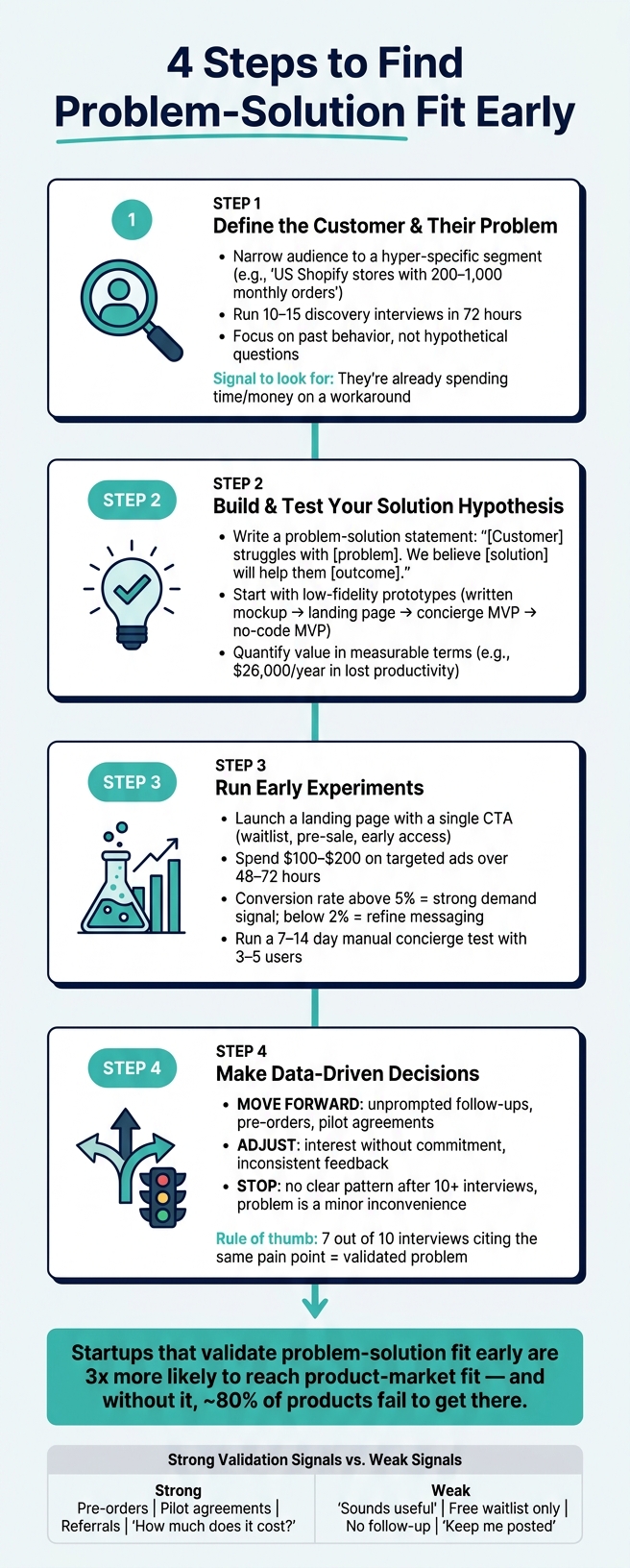 {4 Steps to Find Problem-Solution Fit Early}
:::
{4 Steps to Find Problem-Solution Fit Early}
:::
What Is Problem-Solution Fit In A Startup's Business Model Canvas? - The Startup Growth Hub
::: @iframe https://www.youtube.com/embed/ZXZ7j9pUtJI :::
sbb-itb-127d2b5
Step 1: Define the Customer and Their Problem
Step 1 is all about getting crystal clear on who is experiencing the problem and what that problem is. Without this clarity, any solution you test will likely miss the mark. Skipping this foundational step is one of the main reasons early-stage ideas fail.
Narrow Down Your Target Audience
A vague target audience leads to unreliable data. For example, defining your audience as "small business owners" is too broad to provide actionable insights. Instead, aim for a more specific group, like "US-based Shopify stores processing 200–1,000 monthly orders." This level of detail ensures you gather feedback that’s relevant and actionable [2].
It’s equally important to define who is not part of your target audience. This helps you filter out irrelevant data and focus on the right people [2].
The best sign that you've identified the right audience? They’re already spending time or money on a workaround. As David Wang, Founder at Antler, explains:
"Problem-solution fit focuses on a tiny group of early-evangelists who are comfortable with missing features, as long as it solves their core problem." [4]
These are the people you should prioritize talking to.
Run Problem Discovery Interviews
Once you’ve nailed down your audience, the next step is to uncover their real problems. This requires thoughtful interviews, and the golden rule is to avoid hypothetical questions like, "Would you use this?" People often respond politely rather than truthfully. Instead, base your questions on their past behavior [2][5].
Here’s a simple three-part script to guide your interviews:
- Past: "Tell me about the last time this happened. Walk me through it."
- Present: "How do you handle it today? What breaks?"
- Future: "If this disappeared, what would change for you?" [2]
To find participants, you can use tools like LinkedIn filters to narrow down by job title, or explore niche Slack and Discord communities where potential users discuss workarounds. Reddit threads and 1-star or 2-star reviews on platforms like G2 or Capterra are also goldmines for finding frustrated users [4][5]. Aim to conduct 10–15 interviews within 72 hours to quickly identify patterns [2].
Analyze and Organize Customer Insights
Once your interviews are done, don’t let your findings sit idle. Organize your notes within 48 hours to keep the insights fresh. Break down your notes into individual insights, and group them into clusters with clear themes, like "The Reporting Delay Problem" [8].
Rank these clusters by two key factors: frequency (how often the issue came up) and intensity (how strongly participants expressed frustration). If a specific problem and its workaround show up in at least five interviews, you’ve likely hit on a high-pain issue worth solving [2].
Here’s a quick guide to differentiate between weak and strong validation signals:
| Signal Type | Weak (Polite Interest) | Strong (Real Pain) |
|---|---|---|
| Verbal | "That sounds useful." | "When can I have this?" / "How much?" |
| Behavioral | No follow-up after the interview | Introduces you to colleagues with the same pain |
| Evidence | "I would probably use that." | Shows you the spreadsheet or hack they use today |
| Urgency | "Keep me posted." | "Can I try the prototype this week?" |
Strong signals indicate you’re on the right track with a real, pressing problem. Weak signals, on the other hand, suggest you might need to refine your audience or dig deeper. Once you’ve validated the existence of a high-pain problem, you’re ready to move on to testing solutions.
Step 2: Build and Test Your Solution Hypothesis
Once you've identified a pressing problem for your customers, the next step is to ensure your solution addresses it effectively. After validating the problem, focus on crafting a solution hypothesis and testing it without incurring unnecessary costs. Skip polished builds for now - the goal is to see if your solution genuinely solves the problem. Use the insights you've gathered to confirm whether your idea resonates with your audience.
As Ash Maurya, the creator of Lean Canvas, aptly states:
"Problems, not solutions, create space for innovation." [3]
Write a Clear Problem-Solution Statement
A problem-solution statement is a concise hypothesis that connects three critical elements: your target customer, the validated problem, and a conceptual solution. Think of it as a claim you can test.
Here’s a useful template: "[Target customer] struggles with [specific problem]. We believe [proposed solution] will help them [desired outcome]." The more specific you make each part, the easier it will be to test and refine.
Focus on addressing the root cause of the problem, not just its symptoms. This ties back to the "Job to be Done" that your customer is trying to achieve [1][3]. Aim to create a "Mafia Offer" - a solution so compelling that it’s hard to refuse [3]. If your statement doesn’t generate excitement, experiment with different framings during customer conversations before moving forward [1].
Create Low-Fidelity Prototypes
Before investing significant resources, start with basic prototypes. A simple written description or rough sketch can help you judge whether your concept resonates.
You can also use a concierge approach - manually delivering your solution - to test its viability. For instance, the founders of Airbnb personally enhanced listings, which doubled their revenue in just a month [2]. This approach allows you to validate outcomes before automating processes.
Here’s a quick guide to prototype methods and their ideal uses:
| Prototype Method | Effort Level | Best For |
|---|---|---|
| Written/Mockup | Very Low | Initial resonance and solution interviews |
| Landing Page | Low | Quantitative demand testing and building a waitlist |
| Concierge MVP | Medium | Testing value delivery and willingness to pay |
| No-Code MVP | Medium | Testing retention and workflow integration |
Once you’ve tested the concept, quantify its impact to demonstrate its value.
Define Your Solution's Value in Measurable Terms
Avoid vague promises like "saves time" or "reduces friction." Instead, back up your claims with numbers. Calculate how often the problem occurs, how much time it costs, and what customers currently spend to address it [2].
For example, imagine your target customer is a US-based operations manager who spends 10 hours weekly reconciling data manually. At a fully loaded labor cost of $50/hour, that adds up to $26,000 per year in lost productivity. Numbers like these make it easier to secure real commitments, such as pre-orders, pilot agreements, or letters of intent, rather than just polite feedback [1][4].
As Rahul Vohra of Superhuman demonstrated, identifying users who would be very disappointed without your solution is a stronger indicator of value alignment than feature requests [2].
"Problem/Solution fit validates that you have 'sufficient' demand for your product before building it. It's when you go from hoping people will buy your product to knowing they will." - Ash Maurya, Author of Running Lean [3]
Step 3: Test Problem-Solution Fit with Early Experiments
Once you’ve defined a clear problem-solution statement and identified value metrics in Step 2, it’s time to validate your assumptions through early experiments. These experiments help you gather real-world evidence to back - or challenge - your ideas.
Run Concept and Prototype Tests
Before diving into development, present your concept to potential users. Use a prototype method that aligns with your current stage of testing. The key here is to focus on behavioral commitments rather than casual interest.
What does that mean? Look for actions that show genuine intent, such as users asking about pricing, requesting a demo, or discussing how the solution fits into their workflow. On the other hand, vague comments like "This seems interesting" without follow-up actions likely indicate politeness rather than real interest.
To confirm true engagement, aim for tangible commitments. Examples include pre-orders, letters of intent, or pilot agreements. Without a clear commitment, enthusiasm alone may not be a reliable indicator of demand.
Once you’ve gathered initial feedback, move forward by testing demand with targeted campaigns.
Use Landing Pages and Email Campaigns
Landing pages are a simple and effective way to test interest. Create a page that clearly explains the problem and your solution, paired with a single call to action - like "Join the waitlist", "Get early access", or a pre-sale offer.
Here’s an example: In May 2026, Sarah tested the demand for a scope management tool aimed at freelance designers. She spent just $150 on Instagram ads over three days, directing traffic to her landing page. The result? A 7% sign-up rate and six pre-sales at $9/month for a founding member plan. This demonstrated that her target audience was willing to pay for the solution [9].
As a general rule, a conversion rate above 5% from cold traffic signals strong demand, while rates below 2% suggest you may need to refine your messaging or target audience [9].
"A credit card number is the strongest validation signal you'll find before shipping a product." - Gregory Shepard, CEO, Startup Science [9]
You don’t need a large budget for these tests. Spending $100–$200 on ads over 48–72 hours, targeted at a specific audience, is often enough to gather meaningful insights [9].
If landing page metrics look promising, move on to more hands-on validation.
Run a Manual Concierge or Pilot Test
When your landing page shows positive results, the next step is to deliver your solution manually to a small group of 3–5 users. This “concierge” approach involves personally handling the tasks your product would eventually automate. It’s a hands-on way to measure real-world outcomes and gauge user engagement.
For example, Airbnb’s founders manually enhanced listings to boost revenue for hosts [2]. This type of manual testing helps confirm whether your solution works before investing in automation.
"The concierge approach reveals problems that no amount of interviewing can surface. You'll discover edge cases, workflow mismatches, and assumptions about user behavior that were wrong." - Gregory Shepard, CEO, Startup Science [9]
Run your concierge test for 7–14 days, focusing on metrics like time saved, error reduction, and repeat engagement. If users don’t find value in the manual version of your solution, it’s unlikely that a polished product will change their minds [7].
Step 4: Make Data-Driven Decisions
Now that you've gathered insights from your experiments, it’s time to turn those findings into actionable decisions. The signals you’ve collected will vary, but the key is to focus on the ones that are backed by evidence, not just optimism.
Assess Your Validation Evidence
When evaluating feedback, prioritize behavioral signals over verbal ones. Look for tangible indicators like urgency, willingness to pay, and measurable outcomes. For example, does the user describe a problem that costs them time or money? Have they already pieced together a workaround to address the issue? These are strong signs that the problem is real and pressing.
A handy guideline to follow is the "7/10 Rule": if 7 out of 10 interviews consistently highlight the same pain point and workaround, you’re likely onto something specific and actionable [5]. However, if feedback varies widely across conversations, your problem definition may be too broad.
| Signal Type | Leads to Action | Requires Reassessment |
|---|---|---|
| User Reaction | "When can I have this?" or "How much?" | "That's interesting" with no follow-up |
| Commitment | Pre-orders, deposits, or signed LOIs | Joins a free waitlist only |
| Problem Depth | Actively paying for workarounds | Aware of the problem but not acting |
| Referrals | Proactively introduces others with the same issue | No referrals or only refers when asked |
Armed with these criteria, you can make an informed decision about the next steps.
Decide: Move Forward, Adjust, or Stop
After reviewing the evidence, you’ll need to choose one of three paths:
-
Move forward if users show strong, unprompted interest, such as follow-ups, pre-sales, or pilot agreements. Even small pre-order revenues carry more weight than a large number of waitlist signups [9][2].
-
Adjust if users show interest but lack commitment, or if feedback about your solution is inconsistent. This often means the problem is real, but your approach or target audience may need tweaking [1].
-
Stop if no clear pattern emerges after 10 or more interviews, or if the problem seems to be a minor inconvenience rather than a significant pain point. As David Wang, Founder of Product Academy, explains:
"The ultimate test for early-evangelists is their willingness to pay for your product... If there are signs of hesitation, you are not solving a problem deep enough." [6]
Also, keep in mind the psychological barriers for buyers, such as fear of making a bad decision, reputational risks, or the hassle of switching to a new solution. Even a well-designed product can struggle if users perceive the risks as outweighing the benefits [10].
Use InspectIdea to Support Your Decisions
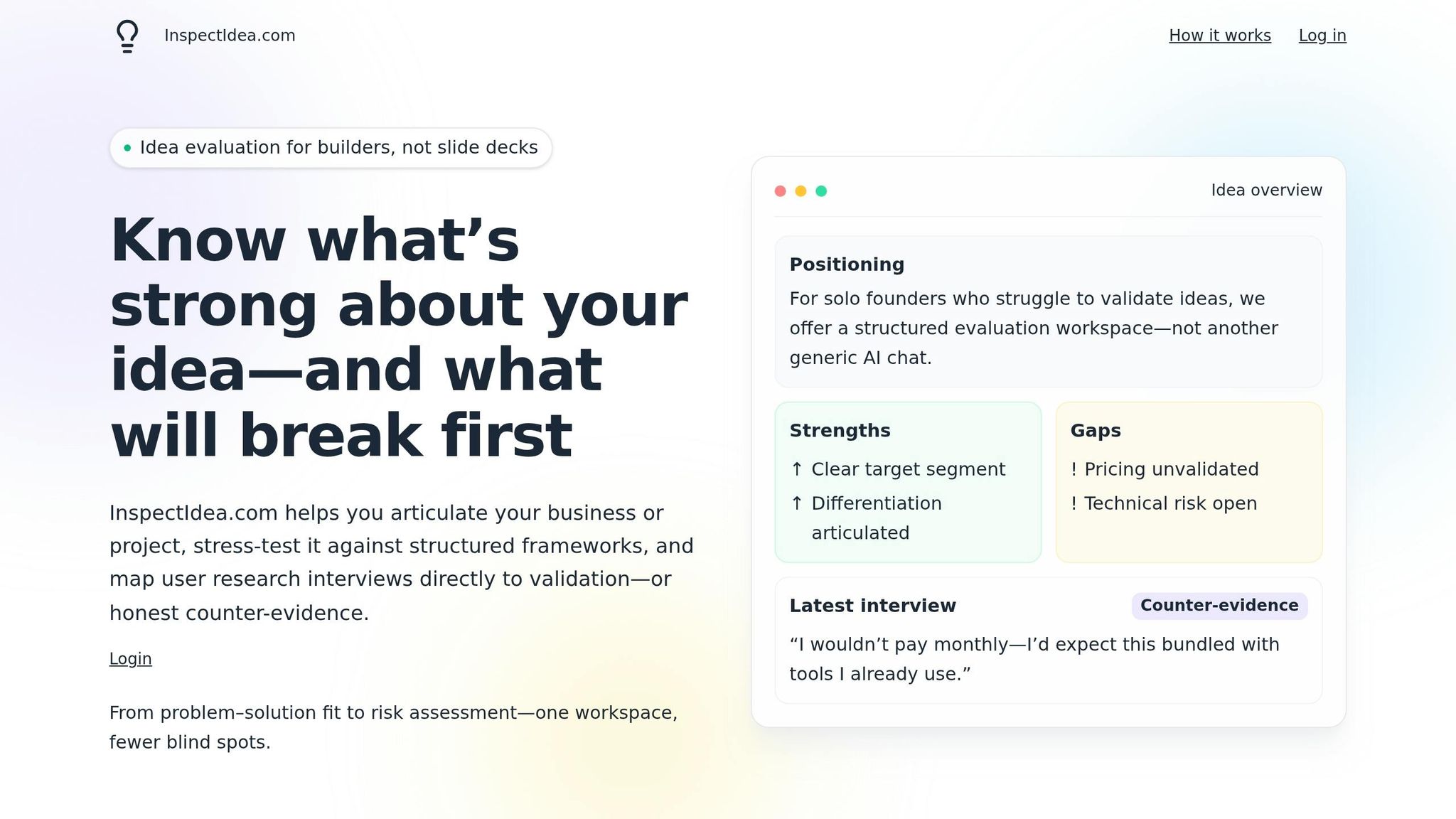
Managing validation data from interviews, landing pages, and other tests can be overwhelming. Tools like InspectIdea simplify this process by providing a centralized workspace for all your insights.
With InspectIdea, you can log findings and tag them as either validation or counter-evidence, helping you avoid relying on memory or scattered notes. Its built-in risk assessment feature highlights gaps in market demand, execution, or finances, ensuring you catch blind spots early. Plus, since it functions as a living document, you can continuously refine your problem-solution statement as new evidence comes in, rather than treating validation as a one-and-done task.
Conclusion: Key Steps to Finding Problem-Solution Fit Early
Finding problem-solution fit isn't about a single "aha" moment - it’s a process of turning assumptions into evidence through careful steps. This guide outlines four key steps: define a focused customer segment, create a testable solution hypothesis, conduct low-cost experiments, and let your data shape the next move.
Successful founders rely on behavioral proof rather than intuition, looking for concrete signals of commitment instead of casual interest.
Research highlights the importance of this stage: achieving problem-solution fit within three months greatly improves the chances of reaching product-market fit [3]. Without it, about 80% of products fail to reach that next stage [3]. These statistics underline the importance of tackling this phase with intention.
Every experiment - from customer interviews to concierge pilots - helps refine your decision to move forward, pivot, or stop altogether.
To make sense of your findings, tools like InspectIdea can help you organize insights and track progress. The ultimate goal isn’t just to confirm your idea - it’s to discover the reality of your solution as early as possible.
FAQs
::: faq
How do I know if a problem is “painful enough” to build for?
A problem becomes "painful enough" when potential customers are already dedicating their time, energy, or money to address it. This often shows up in clear signs such as frequent frustration, reliance on manual workarounds, or detailed accounts of the issue.
Here are some key indicators to watch for:
- Interest in pre-purchasing or signing letters of intent.
- Proactive follow-ups about pricing, availability, or timelines.
However, if customers show no willingness to adjust their behavior or spend money, it’s a strong signal that the problem might not feel pressing or urgent to them. :::
::: faq
What’s the fastest way to validate willingness to pay before building?
The fastest way to gauge if customers are willing to pay is by securing pre-commitments. These can take the form of pre-orders, pilot agreements, or signed letters of intent that include actual dollar amounts. Steer clear of relying on theoretical feedback - what truly matters is securing tangible financial commitments. If potential customers are reluctant to put money or resources on the line, it could signal that the problem isn’t pressing enough or the solution doesn’t quite align with their needs. :::
::: faq
When should I pivot the audience vs. pivot the solution?
If your current audience isn’t engaging with your solution or doesn’t align with the problem you’re addressing, it might be time to shift your focus. Seek out a group that feels the issue more acutely - those who experience the problem on a deeper or more frequent level.
On the other hand, if your audience acknowledges that the problem is real and pressing but doesn’t see your solution as effective, it’s worth rethinking your approach. Gather their feedback and use it to refine your ideas through prototypes or small experiments. This way, you can test and adjust before fully committing to a larger-scale implementation. :::