Top 7 Frameworks for Validating Business Assumptions
Most startups don’t fail because they build too slowly. They fail because they build on guesses. The article’s main point is simple: if you rank your riskiest assumptions first, then test them with the right framework, you cut wasted time and bad bets.
I’d boil it down like this:
- Start by listing assumptions
- Rank them by impact and proof
- Use the right framework for the right question
- Set pass/fail rules before each test
- Update your plan based on what people do, not what they say
The article covers 7 frameworks: Assumptions Mapping, Lean Startup, Lean Canvas, JTBD, Business Model Canvas, Hypothesis-Driven Experimentation, and Customer Discovery Interviews.
Two numbers stand out:
- 42% of startups fail because there is no market need
- A Business Model Canvas can hide 20 to 40 assumptions, while a Lean Canvas or BMC often rests on many more small guesses underneath
If I had to sum up the whole piece in one line, it would be this: don’t treat assumptions like facts; treat them like tests waiting to happen.
Testing Business Ideas: Assumptions Mapping Webinar
::: @iframe https://www.youtube.com/embed/Am598Cbq5gU :::
Quick Comparison
| Framework | Best for | What I’d use it to check | Main weak spot |
|---|---|---|---|
| Assumptions Mapping | Sorting risk early | Which guesses could sink the idea first | It can stay stuck as an internal exercise |
| Lean Startup Loop | Fast test cycles | Demand, use, and early business signals | Teams can test the wrong thing |
| Lean Canvas | Early startup planning | Problem, customer, value prop, channels | Less useful for later company detail |
| JTBD | Demand discovery | What progress the customer wants | It doesn’t test price well |
| Business Model Canvas | Full business view | Revenue, segments, partners, costs | Teams may focus on easy boxes |
| Hypothesis-Driven Experimentation | Clear pass/fail tests | One risky assumption at a time | Results can get twisted after the test |
| Discovery Interviews | Early problem checks | Pain, behavior, buying process | Nice words are not proof |
I see the article as a sequence, not a set of random tools: canvas first, mapping next, interviews after that, then experiments. That flow helps you move from opinion to proof with less guesswork.
How to Use These Frameworks
Use each framework the same basic way: define an assumption, rank the risk, test it, and then update the plan. Each framework looks at the problem from a different angle, but the loop doesn't change.
Three terms show up again and again:
- Desirability - Do customers have this problem, and do they want your solution?
- Feasibility - Can you build and deliver it within technical, legal, and regulatory limits?
- Viability - Can the business generate steady revenue and profit from it?
The part that matters most early on is prioritization. Not every assumption can sink an idea. Some are minor. Others are make-or-break.
A simple way to sort them is with a 2×2 matrix: how much impact would this assumption have if it's wrong? and how much evidence do you already have? The assumptions in the high-importance, low-evidence corner are your highest-risk assumptions. Test those first.
That sounds simple, but it's easy to skip. And when teams skip it, they often run tests that produce answers to the wrong question. Rank assumptions before testing so the experiment checks what matters most. That ranking also helps you decide which framework to use first.
After you run your tests, compare the results against your pre-set criteria. Then decide whether to pivot, persevere, or drop the idea. It also helps to keep assumptions and test results in one place. InspectIdea can centralize assumptions and test results in one workspace.
With the riskiest assumptions identified, start with Assumptions Mapping.
1. Assumptions Mapping
Assumptions Mapping helps you lay out the beliefs your business model rests on before you start building. A typical Business Model Canvas has 15 to 30 underlying assumptions [1], and some matter a lot more than others. This framework is built to spot the assumptions that can sink the idea fast. That’s why it’s often the first one to use when you need to sort major risks from minor ones.
Primary assumptions tested
These assumptions usually fall into three buckets: desirability, feasibility, and viability [9].
Best stage of use
This framework works best right at the start - after you’ve sketched out a product idea or mapped a business model, and before you’ve spent much on building [9]. A solid mapping workshop usually takes 2 to 4 hours and works best with a cross-functional group. Bring in product, engineering, design, and commercial leads so the team can spot blind spots that one person might miss [9].
Typical evidence sources
Once the assumptions are ranked, test the ones in the top-right quadrant with simple RATs. Rank each assumption by impact and evidence, then start with the high-importance, low-evidence quadrant [9]. That’s usually where Riskiest Assumption Tests (RATs) come in.
For example:
- Customer interviews and landing page smoke tests for desirability
- Pricing tests and letters of intent for viability
- Technical proofs of concept for feasibility [1][9]
Main limitation
The map reflects internal beliefs, not proof from the market. Set a fail criterion before you run tests - for example, "at least 5 of 20 customers must sign a letter of intent" - or it becomes too easy to explain away weak results [1]. It also helps to update the map every 2 to 4 weeks as new evidence shifts the ranking [9].
2. Lean Startup Build–Measure–Learn Loop
Once you've mapped the risks, this loop helps you test the biggest assumptions FAST. The Build–Measure–Learn loop is a simple cycle for turning assumptions into evidence in as little time as possible. You build the smallest test you can, measure what real customers do, and then decide whether to keep going, pivot, or stop. Each round should tie back to the ranked assumptions from your mapping work.
Primary assumptions tested
This loop is meant for high-risk assumptions, especially around three big questions:
- Do customers want this?
- Can you build it?
- Can the business make money?
In day-to-day use, that often means testing whether the problem is real, whether a certain customer segment cares, whether the value proposition lands, whether acquisition channels are workable, and whether the unit economics make sense. [12][13]
Best stage of use
This framework is strongest in early-stage validation, especially when you're trying to find product-market fit or test a new product, feature, or market segment. It works best when you already have a clear hypothesis and can run a small test in days, not months. [15]
Typical evidence sources
Focus on actionable metrics, not vanity metrics. Good signals include 7-day and 30-day retention, activation, conversion to paid, and payment intent. Common tests include landing pages, concierge tests, Wizard-of-Oz experiments, and clickable prototypes. [12][13][14]
Main limitation
This loop sounds simple, but it takes discipline. A weak experiment can give you bad signals, and the framework doesn't say much about what to test first or how to shape the test itself. Teams can end up chasing small gains while missing the better move at the business level. That's why it helps to set a pass/fail threshold before you run the test. [12][16]
If you need a one-page view of the business logic before testing, Lean Canvas is the next step.
3. Lean Canvas
Lean Canvas is Ash Maurya's one-page business model grid for surfacing the assumptions behind a new venture fast: Problem, Customer Segments, Unique Value Proposition, Solution, Channels, Revenue Streams, Cost Structure, Key Metrics, and Unfair Advantage. The big draw is speed. When everything has to fit on one page, the team has to put its biggest unknowns on the table early.
"The goal with a Lean Canvas isn't to achieve perfection but to take a snapshot." - Ash Maurya, Creator of Lean Canvas [17]
Primary assumptions tested
Lean Canvas tests desirability, viability, and feasibility. Early on, the riskiest blocks are often Problem and Customer Segments.
Best stage of use
Lean Canvas works best for pre-MVP teams, when there's still a lot of uncertainty around pricing, channels, and customer needs.
Typical evidence sources
A Lean Canvas is only as useful as the evidence behind it. A good starting point is:
- 10–15 customer interviews to test Problem and Customer Segments
- Landing pages to gauge demand for the UVP
- Fake door tests to check price sensitivity
- Concierge MVPs to validate the core value proposition by hand [18][19][13][21]
Each test maps to a specific block on the canvas. That makes the tool practical, not just theoretical. You’re not filling boxes for the sake of it - you’re checking whether the story in the canvas holds up in the market. These tests can show demand signals, but they don't replace direct market proof.
Dropbox's early demo video is a well-known example of using a simple test to validate demand before building [22].
Main limitation
The most common mistake is treating the canvas like a one-and-done file instead of a living document. Markets shift, ideas change, and early guesses often miss the mark. If the canvas stays frozen, it stops being useful.
It also leaves out the operating detail needed for scale, so it becomes less helpful once the business model is already known [19][20]. InspectIdea offers a workspace for tracking assumptions and the evidence used to test them.
Once the canvas points to the riskiest blocks, Jobs to Be Done can help test whether customers want the outcome you think they do.
4. Jobs to Be Done (JTBD)
After you define the problem in a canvas, JTBD checks whether customers are hiring the right solution for the right job.
The big shift is simple: instead of asking, "Who is our customer?", JTBD asks, "What progress is the customer trying to make?" People hire products to get a job done in a given situation. And when a better option shows up, they fire that product and switch [23][24].
Primary assumptions tested
JTBD pushes back on three ideas teams lean on all the time.
- Demographics drive buying behavior. JTBD shows that demand usually comes from the situation, not the persona.
- Competitors are only products in your category. In practice, the other option might be a spreadsheet, a manual workaround, or doing nothing at all.
- Customers want features. Most of the time, they want an outcome.
A job also has three parts:
- Functional: the practical task the person needs to complete
- Emotional: how they want to feel while doing it
- Social: how they want other people to see them
Miss one of those, and you can end up with a product that works on paper but still gets fired.
That’s why JTBD is often a better way to look at demand than demographics alone.
Best stage of use
JTBD works best in early discovery, before you build an MVP. It’s extra useful in crowded markets, where the biggest competitor may not be another startup. It might be a clunky spreadsheet, a patchwork process, or no action at all.
Typical evidence sources
One of the main evidence sources is the Switch Interview. This is a retrospective conversation with someone who recently moved from one solution to another. The goal is to rebuild the exact moment they decided to change, including what pushed them away from the old option and what pulled them toward the new one.
JTBD patterns usually start to show up after 8–12 interviews on the same job [25]. Another strong signal is the workaround. If users are building messy spreadsheets or manual processes, that often points to an unmet job.
These interviews matter because they show the trigger behind the switch, not just what people say they like.
Main limitation
JTBD checks demand, not feasibility or pricing [15][16]. It also leans hard on interview skill. If the interview is done poorly, the output can turn into a list of feature requests instead of actual job insights [26]. To sort the assumptions JTBD brings up and the evidence behind them, InspectIdea can help keep that research in one workspace.
sbb-itb-127d2b5
5. Business Model Canvas
Once JTBD spells out the customer’s job, the Business Model Canvas helps you map the rest of the business around it. The Business Model Canvas (BMC) is a one-page view of nine business model blocks. It works best as a working set of hypotheses, not a finished plan. The goal is simple: surface assumptions, then sort the riskiest ones for testing.
Key assumptions tested
A typical BMC session can surface 20 to 40 individual assumptions [6]. Start with Customer Segments, Value Propositions, and Revenue Streams. Those three blocks get at desirability, viability, and feasibility. And in practice, that’s where teams often find the biggest risks: customer demand and revenue.
Best stage of use
The BMC is most useful in the pre-MVP stage, when a team needs to get aligned on the business model before building. After you spot the riskiest blocks, label each one based on its status. A simple color system works well for showing what’s validated, partially checked, or still untested.
Typical evidence sources
For Customer Segments and Value Propositions, use 10 to 15 discovery interviews. For Revenue Streams, look for commitment signals like pre-sales, letters of intent, or deposits [6][1].
For partner and resource assumptions, useful evidence can include:
Main limitation
On its own, the BMC can turn into a static list of guesses. That’s the trap. Pair it with an Assumption Priority Matrix so the team can focus on assumptions with the most impact and the most uncertainty [6][1]. It also helps to track validated and untested assumptions in one shared workspace.
Once the canvas shows you the weakest assumptions, the next move is to test them with hypothesis-driven experiments.
6. Hypothesis-Driven Experimentation
Once you know which assumptions carry the most risk, the next move is to turn each one into a hypothesis you can test.
This is hypothesis-driven experimentation in plain English: you use the scientific method for business choices. Instead of running on instinct, you take a risky belief and turn it into a statement you can check with evidence. A good hypothesis follows a simple format: "We believe [customer] will [action] because [reason]. Success means [metric]." [28] That last part matters most. The threshold gives you a clear pass or fail, which is what separates a test from an opinion.
Primary assumptions tested
Use RATs on the single assumption most likely to break the model.
Best stage of use
Use this framework after assumption mapping, when you're ready to test the riskiest bet and before major engineering work or big capital spend. [27][11]
Typical evidence sources
Behavior beats stated intent. What people do tells you much more than what they say they’ll do. A click on a pre-order button, a signed letter of intent, or a paid deposit says far more than a polite “yes, I’d use that.” [29]
Main limitation
Set the pass/fail threshold before the test starts. If you don't, it's far too easy to explain away weak results after the fact.
Tools like InspectIdea can help here. They give teams a clear place to document assumptions, track evidence, and tag findings as validating or contradicting, so the record stays honest during the process.
7. Customer Discovery and Validation Interviews
After you map your riskiest assumptions, use discovery interviews to find out if the problem is real and worth solving. This is one of the strongest early validation methods, and it works best before you build anything.
Primary assumptions tested
This framework tests the core assumptions under your business:
- Problem severity - Is the pain real, repeated, and urgent enough to make people act?
- Current behavior - How are people dealing with this problem today, and what are they already spending time or money on?
- Buying behavior and willingness to pay - Who makes the call, what starts the buying process, and is the pain costly enough that people will pay to fix it?
Best stage of use
Run discovery interviews before you build - before an MVP and before you commit engineering time.
Typical evidence sources
Past behavior is the strongest signal. Ask "Tell me about the last time this happened" instead of "Would you use this?" [35]
Here’s a simple way to sort signals from weak to strong:
| Evidence Level | What It Tells You | Signal Strength |
|---|---|---|
| Opinion | People like the concept | Weak |
| Problem Story | The pain is real and recent | Moderate |
| Current Behavior | People already spend time or money on workarounds | Strong |
| Commercial Commitment | People pay, sign LOIs, or share internal data | Very Strong |
This helps you sort ideas into a few buckets: maybe it’s just interesting, maybe it hurts, maybe it’s urgent, or maybe it’s worth paying for.
Another strong clue is unprompted frustration. If someone says "it drives me crazy" without being pushed there, pay attention. That kind of reaction usually means the pain is close to the surface. [30][4]
Main limitation
The biggest trap is politeness bias. People often tell you what sounds nice, not what they’d do in real life. A vague "that sounds really interesting" is not validation.
If the conversation ends with no next step - no follow-up meeting, no intro to a decision-maker, no form of commitment - treat that signal as weak. [31][32]
A good starting point is about 10–15 interviews per customer segment. By the 8th to 10th conversation, patterns should start to show up. If you’re still hearing major surprises after 15 interviews, your segment may be too broad. [34][33]
After each session, write up your notes within an hour. The exact words people use matter more than most founders think. Later, that language often turns into some of your best marketing copy. [2]
InspectIdea can tag interview notes by assumption, which makes patterns much easier to spot.
Use what you learn here to compare this framework with the others below and decide on the next test.
Side-by-Side Comparison of All 7 Frameworks
::: @figure 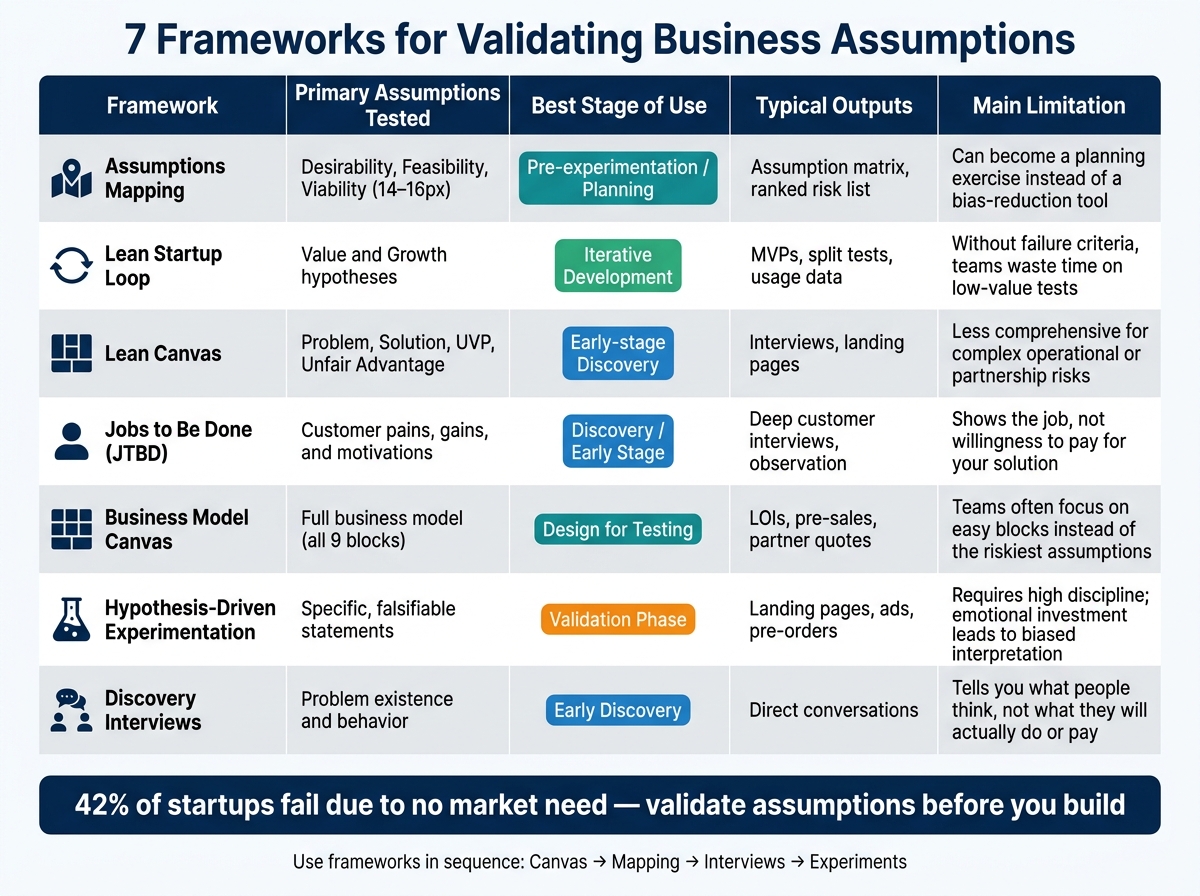 {7 Business Assumption Validation Frameworks Compared}
:::
{7 Business Assumption Validation Frameworks Compared}
:::
Each framework checks a different assumption at a different point in the process.
So the job isn’t to choose the most popular framework. It’s to choose the one that fits the risk you need to test.
The table below breaks down what each framework tests, when it makes sense to use it, what kind of proof it tends to produce, and where it falls short.
| Framework | Primary Assumptions Tested | Best Stage of Use | Typical Outputs | Main Limitation |
|---|---|---|---|---|
| Assumptions Mapping | Desirability, Feasibility, Viability | Pre-experimentation / Planning | Assumption matrix, ranked risk list | Can become a planning exercise instead of a bias-reduction tool [8] |
| Lean Startup Loop | Value and Growth hypotheses | Iterative Development | MVPs, split tests, usage data | Without failure criteria, teams waste time on low-value tests [1] |
| Lean Canvas | Problem, Solution, UVP, Unfair Advantage | Early-stage Discovery | Interviews, landing pages | Less comprehensive for complex operational or partnership risks [6] |
| Jobs to Be Done (JTBD) | Customer pains, gains, and motivations | Discovery / Early Stage | Deep customer interviews, observation | Shows the job, not willingness to pay for your solution [10] |
| Business Model Canvas | Full business model (all 9 blocks) | Design for Testing | LOIs, pre-sales, partner quotes | Teams often focus on easy blocks instead of the riskiest assumptions [6] |
| Hypothesis-Driven Experimentation | Specific, falsifiable statements | Validation Phase | Landing pages, ads, pre-orders | Requires high discipline; emotional investment often leads to biased interpretation [1] |
| Discovery Interviews | Problem existence and behavior | Early Discovery | Direct conversations | Tells you what people think or feel, but not what they will actually do or pay [10][5] |
Use this comparison to choose the next test based on the kind of assumption in front of you, not the framework’s name.
Next, Lean Canvas and Business Model Canvas deserve a direct comparison because teams often mix them up.
Lean Canvas vs. Business Model Canvas
Here’s the simple rule: use Lean Canvas early, then move to the Business Model Canvas once the idea has some proof behind it.
The two tools look similar on the page, but they do different jobs. The Business Model Canvas (BMC) maps the business as a whole. Lean Canvas zooms in on the riskiest bets behind a new idea.
That’s the big shift.
Lean Canvas swaps out Key Partners, Key Activities, Key Resources, and Customer Relationships for Problem, Solution, Key Metrics, and Unfair Advantage. In plain English, it pulls the focus away from how the business runs and puts it on what might fail first: the problem, the proposed fix, and the core assumptions behind both [36][37][38].
| Feature | Lean Canvas | Business Model Canvas |
|---|---|---|
| Primary Focus | Problem-solution fit and risk validation | Full business system and operating model |
| Scope | Product-centric, startup-oriented | Broader, company-wide planning |
| Level of Detail | Stronger on problem, metrics, and unfair advantage | High on infrastructure, partners, and activities |
| Primary Use | Validating new ideas and high-risk hypotheses | Redesigning existing models or scaling validated ideas |
| Target Audience | Founders and small product teams | Cross-functional teams, investors, and boards |
A good way to think about it: Lean Canvas helps you test whether the idea deserves to live. BMC helps you map how it will run once it does.
So if you’re still trying to figure out whether customers care about the problem, start with Lean Canvas. After early demand is proven, switch to BMC to map partnerships, costs, and customer relationships.
For team workshops, don’t jump straight into one shared version. Have each person fill out the canvas on their own first, then compare notes. That simple step often brings hidden disagreements to the surface before the team locks itself into one model.
How to Combine These Frameworks in Practice
Use the comparison above to pick the next test, then link the frameworks in this order. No single framework does it all. Teams that move fast use these tools as a sequence, not a menu. Each step gives the next one something to work with.
Start with Lean Canvas or the Business Model Canvas to make your core assumptions visible. Pull those assumptions out of the canvas, then run them through Assumptions Mapping. Plot each one on a 2×2 grid based on importance and evidence. That gives you a clear ranking, and that ranking shows which assumptions should move into interviews and experiments next.
Once you've ranked the riskiest assumptions, bring in Jobs to Be Done and structured customer interviews to figure out why the problem exists before you build a solution. JTBD clarifies the job. Interviews check whether the problem is real. Put simply, this is how you explain the behavior behind the data.
When the why is clear, turn the top assumption into a testable hypothesis. For each top-priority assumption, write a specific hypothesis and define fail criteria before you run the test. For example, set a minimum share of unprompted confirmation in advance. That makes it easier to strip out emotional bias when the results come in. [1]
Then run the Build–Measure–Learn loop using the smallest, cheapest experiment that can move the assumption from untested to validated or invalidated.
Keep each test short so the team doesn't lose momentum. After every major test, update the canvas and use each result to shape the next one.
Conclusion
Put together, these frameworks help move an idea from gut feeling to proof. The best way to use them is in sequence: surface assumptions, rank risk, test the weakest links, then keep refining.
Start with the framework that fits your biggest risk. Early-stage ideas often need customer discovery interviews or JTBD. If you're trying to check demand, use landing page tests or smoke tests. And if the stakes are high, set clear fail criteria before you run the experiment.
Validation isn't about proving your favorite idea right. It's about finding what breaks first. That discipline matters: 42% of startups fail because there is no market need [7]. Once you've mapped the riskiest assumptions, the next move is clear: plot them on a 2×2 grid by importance and evidence, then tackle the high-importance, low-evidence quadrant first. Those are the assumptions most likely to kill the idea if they fail [1][8][3].
FAQs
::: faq
Which framework should I start with?
Start with your Riskiest Assumption Test (RAT).
First, map the core assumptions behind your business model. That usually means getting clear on a few basic things:
- Who your customer is
- How painful the problem is for them
- Whether they’ll pay to fix it
Then sort those assumptions by risk and test the one that matters most. In plain English: if that assumption is wrong, the whole project falls apart.
InspectIdea can help you organize this process. :::
::: faq
How do I rank my riskiest assumptions?
Use Assumptions Mapping to spell out what has to be true for your idea to work.
Look at the idea from four angles:
- Desirability: Do people want it?
- Feasibility: Can you build and deliver it?
- Viability: Can it make money or support itself?
- Adaptability: Can it keep working as conditions change?
Then place each assumption on a simple 2x2 matrix. Put importance on the vertical axis and evidence on the horizontal axis.
That gives you four zones, but one matters most: the assumptions that are high importance and low evidence. Those are your leap-of-faith assumptions.
Those are the ones to test first. :::
::: faq
What counts as strong validation evidence?
Strong validation comes from what people do, not what they say.
If someone tells you they’d use your product, that’s weak proof. People are often polite. They may mean well. But talk is cheap.
What matters is actual behavior. You want signals that show real commitment. That usually means a person is willing to spend time, spend money, or take a step that has some cost.
The strongest signs include actions like:
- spending time or money
- signing a letter of intent
- placing a pre-order
- joining a paid waitlist
That kind of response carries more weight than interest or encouragement because it shows the person is willing to act, not just nod along. :::